Why this Drop?

I was saying in the last update that a bottom on the Kama average (daily chart) is a high and strong bottom, which suggests new highs coming.
This is not happened and usually, I emphasize usually, if after a relatively high bottom we do not have a new top what happens is that it may develop a sustained decline and is exactly what has happened in recent days.

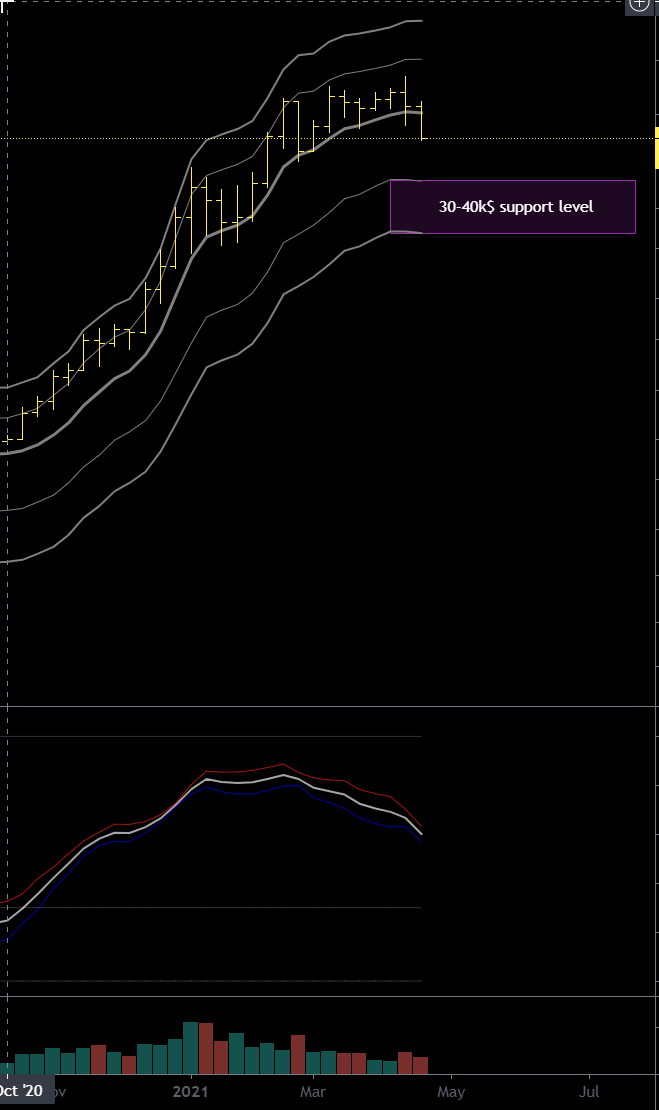
This behaviour in my opinion can be explained by the situation on the weekly chart that i already pointed out in the long term update of last January 19, 2021.

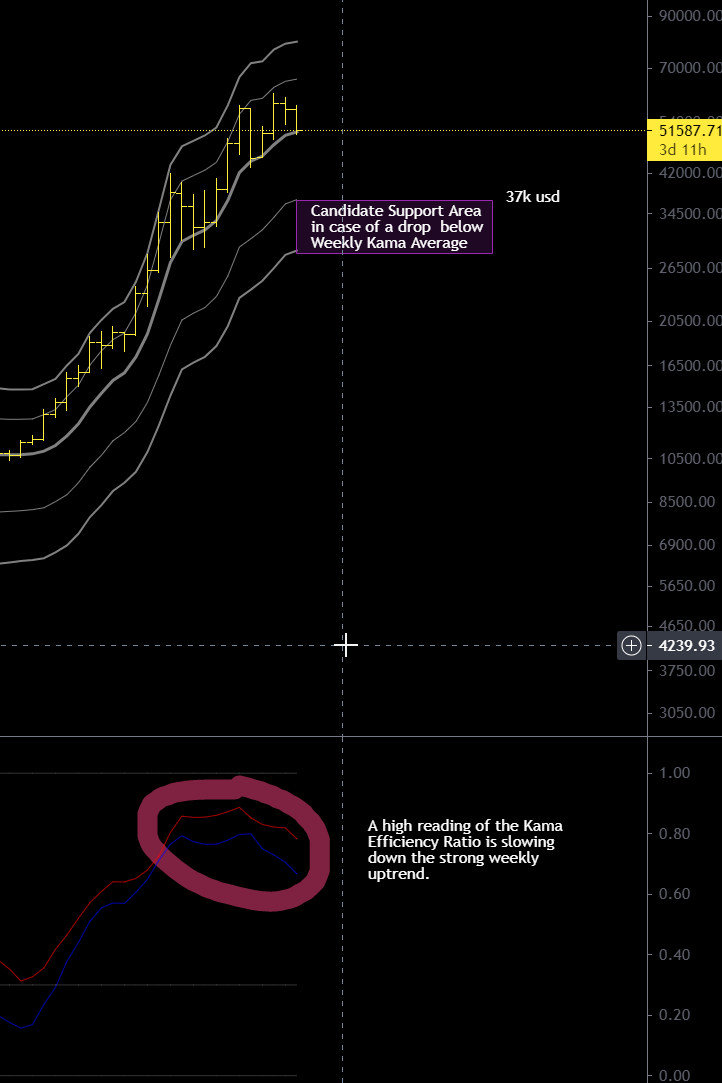
In the chart below you can see that once arrived around 0.85 the kama efficiency ratio has begun to decline slightly, the consequence on the graph is a slowdown of the weekly trend in progress.
I do not think that the consolidation phase of the Kama ER (eff.ratio) is over, therefore the risk is that the lower part of the bullish channel might be tested, with the first support at 37 thousand dollars and the next at around 29 thousand dollars.
This risk of a drop exists and could materialize in the coming weeks, therefore the operating strategy requires a change, the stop loss that I once suggested at $35,000 could be too close and should be moved below $29,000 to remain protected from the volatility of this market. You don’t want to get caught by the market at the bottom and then see the train leave without you on board:)
Stay alert and lucid because a good buying opportunity could be coming, between $29K and $37K. It’s crucial to see if these days BTCUSD will stay or not above weekly kama at 51,000$

BTCUSD Weekly Chart

Short Term Update: Bullish development

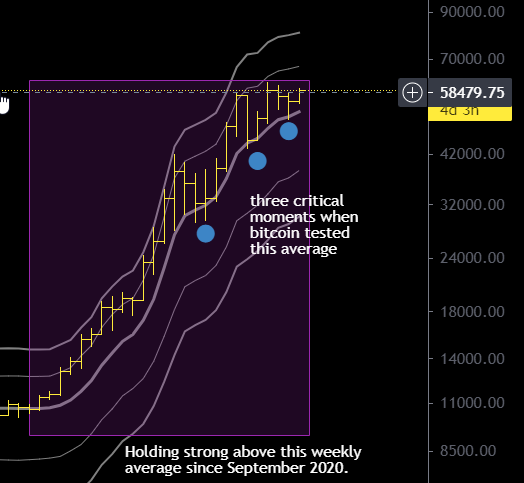
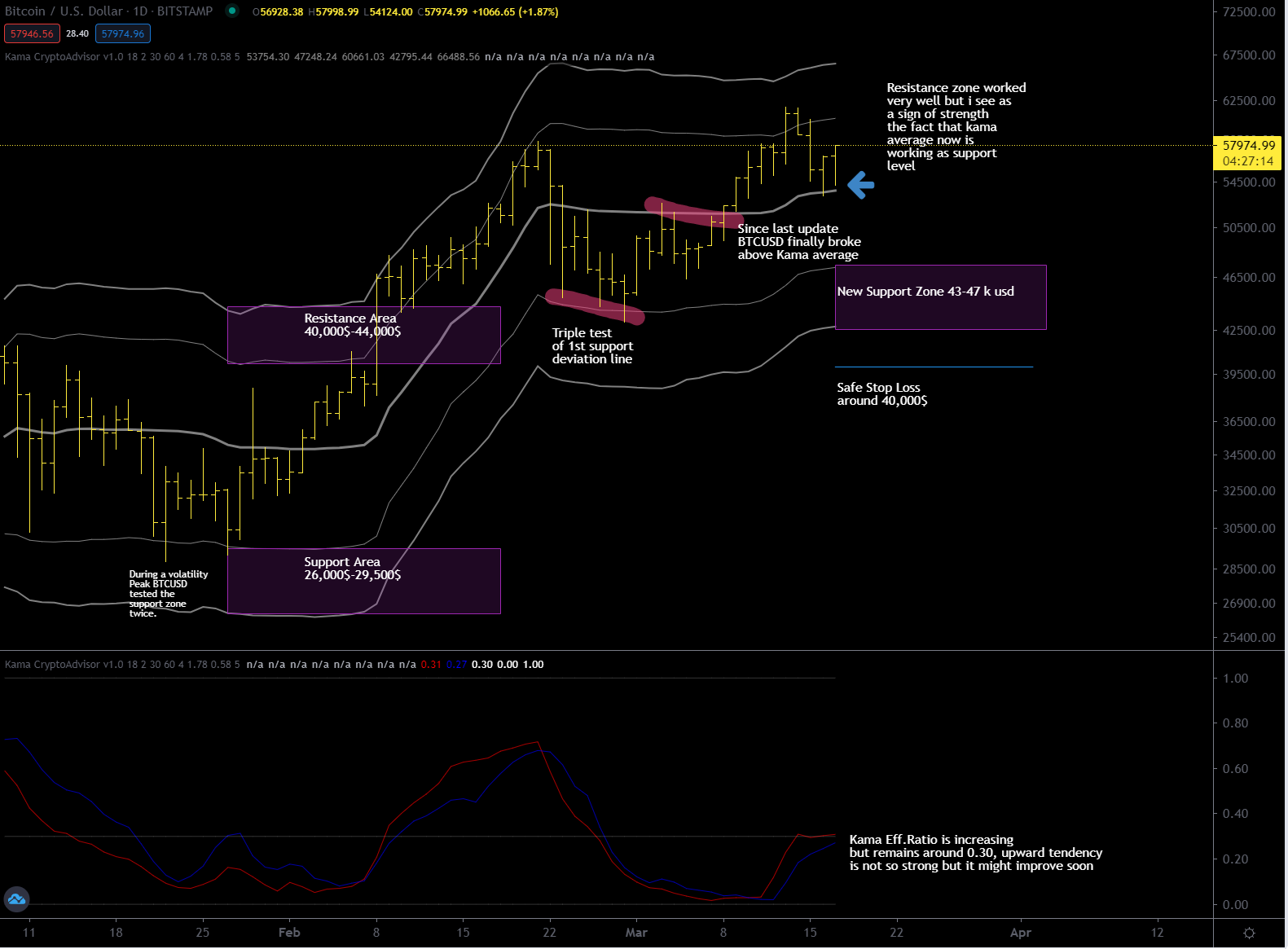
Since the last update bitcoin was flat and below the daily Kama average, it managed to break to the upside and what happened in the last 10 days is a positive development.
We don’t have a confirmed upward trend yet but we are almost there, the efficiency rate of the Kama average is at 0.30 on the limit value that separates the “flat mode” from the “trend mode”.

BTCUSD Daily Chart

I don’t think we’re going down to the support zone between $43k and $47k, I think we’re going to go into the new resistance zone with a resistance level around $67k.
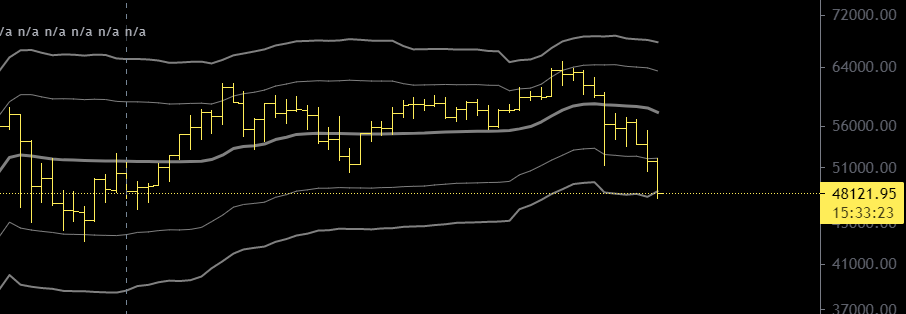
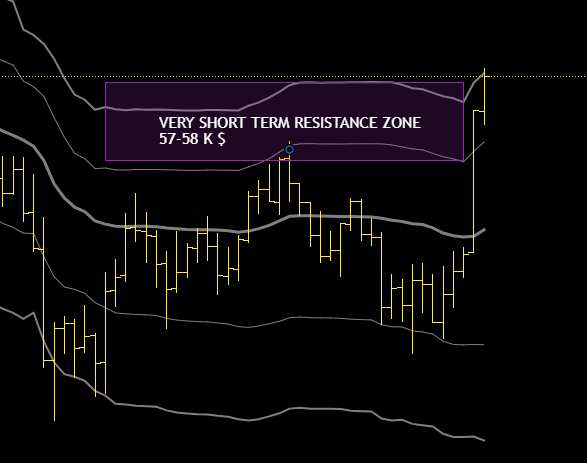
For those who want to follow the trend can use the hourly chart as reference for entries, right now the bitcoin is trying to force the resistance at $58000.

BTCUSD Hourly Chart

I usually don’t use the hourly chart with this indicator, it would be necessary to look for settings that are good for intraday charts but this time it looks good, that resistance zone is working and a breakout would imply a confirmation of the daily bullish trend.

Short Termp Update: Again Flat, “Ad infinitum”

Because of cyclicality of the things that surround us also the markets oscillate endlessly between phases of congestion and trend, between moments in which the volatility/trend ratio is almost zero to others in which it is maximum.
By dint of following my updates I hope you will succeeded in understanding this fundamental concept, then you will begin to look at the markets for what they are, balloons that continuously inflate and deflate or alternatively, if you don’t like the metaphor, a breathing lung.

Kama Efficiecny Ratio – 8 Years of BTCUSD Breath

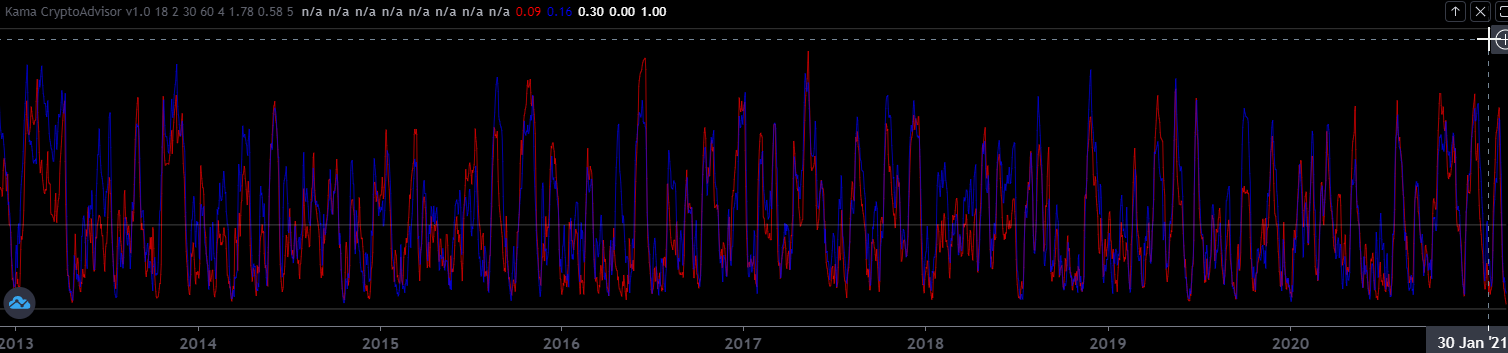
The image above represent the last 8 years of the bitcoin/dollar kama efficiency ratio. As you can see for yourself, when the market peaks immediately the volatility trend ratio drops because the market takes a break, exhaling the previously inspired air.
With BTCUSD there is a strong 60-day cycle in the Kama Efficiency Ratio indicator, it means that , on average, 60 days separate two peaks in this indicator, it does not necessarily mean that there are 60 days between two highs or between two lows, due to the nature of this indicator it can happen that there are 60 days between a low and a high or between two lows or between two highs. I hope to be clear on this concept to avoid confusion but a peak in the Kama Efficiency Ratio does not necessarily mean that there is a top, it can also be a market low.

Can we use this information to try to predict the next spike on the kama efficiency ratio? We can but we must evaluate the results with caution.
The last peak happened on February 21, so the next peak could be around April 20, where we will have either a Top or a Bottom.
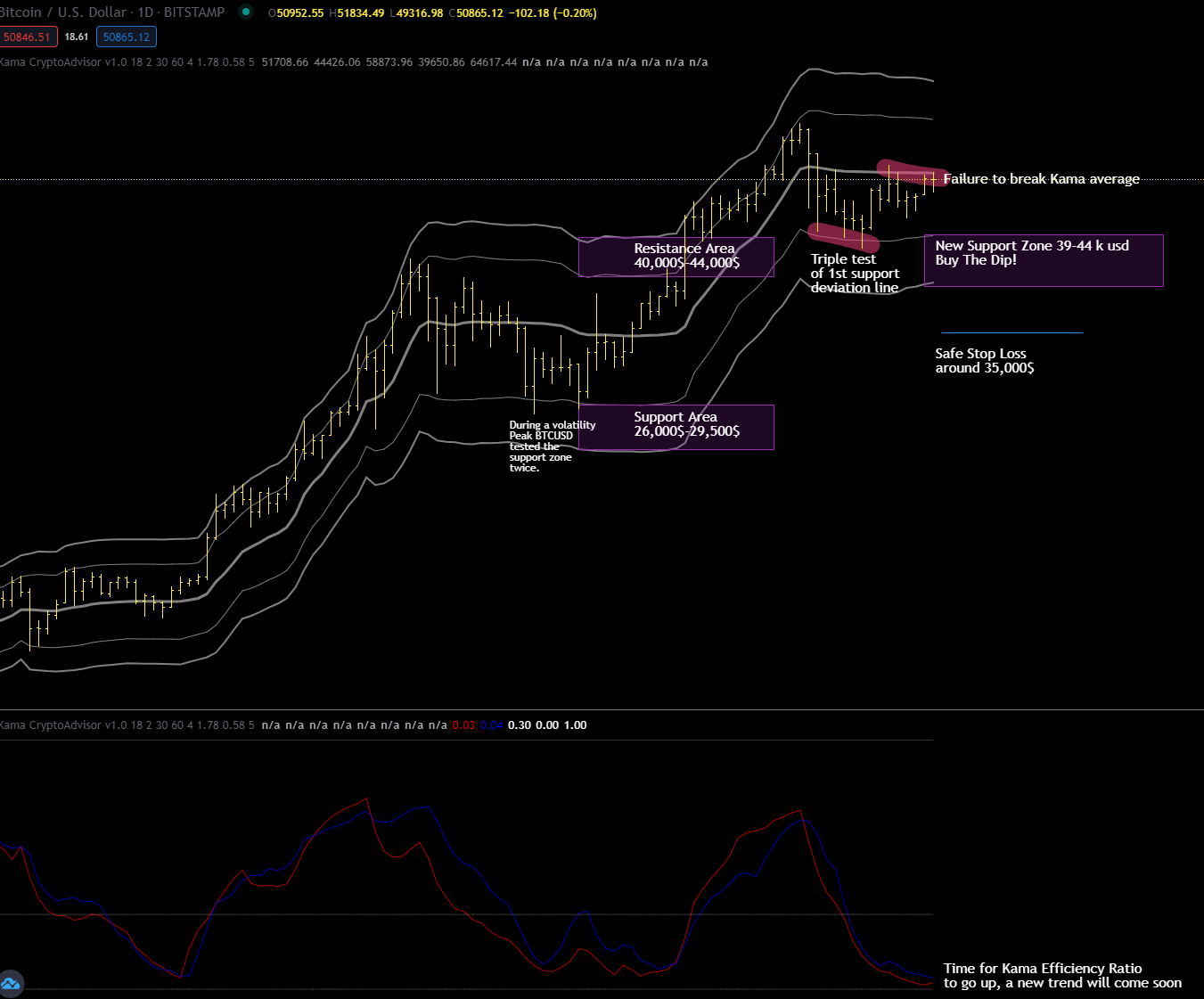
For now, as you can see in the chart below, the Kama efficiency Ratio is very low, in fact BTCUSD is flat and between the Kama average and the first line of support, tested 3 times in recent days.

If you got the metaphor, now is the time for the “bitcoin animal” to start with a new “inhale, exhale” cycle, the volatility/trend ratio (Kama E.R.) is very lows soon we will have a new established trend on the daily chart.
In case of a downtrend the next bottom could be inside the support zone, between 39 and 44 thousands dollars; if an uptrend will develop the next target could be towards the resistance area near 65 thousands dollars.

Ok guys, I leave you saying that I moved my stop loss to 35000 dollars, it now has become a stop order to protect the profits achieved so far. See you at the next update.

Short Term Update: Volatility is back

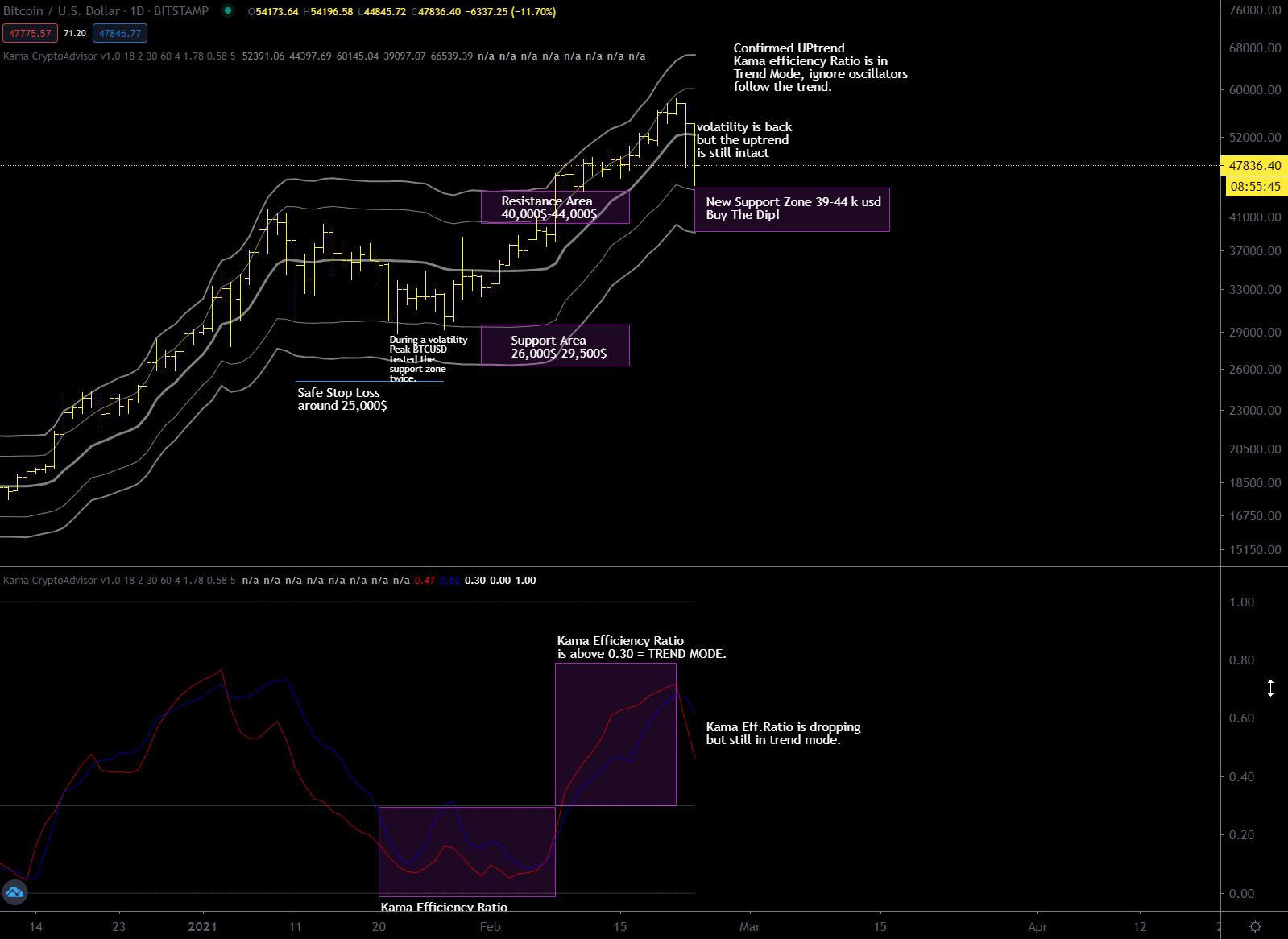
The volatility is back, to be honest I had suspected two days ago that Bitcoin was running out of fuel, even some profit taking evident on the hourly chart had let me think so and then yesterday that volatility peak was the confirmation.
Despite this, at a careful and lucid analysis, the situation on the daily chart has not changed, we are still in trend mode and it is not guaranteed that Bitcoin will go sideways in the next days.
In any case, pay particular attention to the support zone between 39 and 44 thousand dollars, it is very important to stay above 39 thousand dollars in order not to compromise the ongoing bullish trend.

BTCUSD Daily Chart – Kama average and deviation bands | Kama efficiency ratio

The most keen observers will have noticed that after a prolonged bullish trend, the kama efficiency ratio had reached 0.71, which is beginning to be an important value. Personally I see the correction of these two days as absolutely normal and also necessary in order to continue.
I would also add that this market did not go down because of Janet Yellen’s statements, news are always a consequence of market forces and never the cause. I explained in the past, for those who have been following me for some time on the blog, that when a bearish phase starts, the negative news will be amplified and the positive ones ignored, vice versa when a bullish phase starts, the negative news will be ignored and the positive ones will be amplified, but it is never the news in itself that moves the market.

Short Term Update: Back to “Trend Mode”

I waited a while before updating you about the short term situation because i wanted to see if the trend confirmed by the Kama efficiency rate was good and not a false signal.

BTCUSD – Daily Chart View

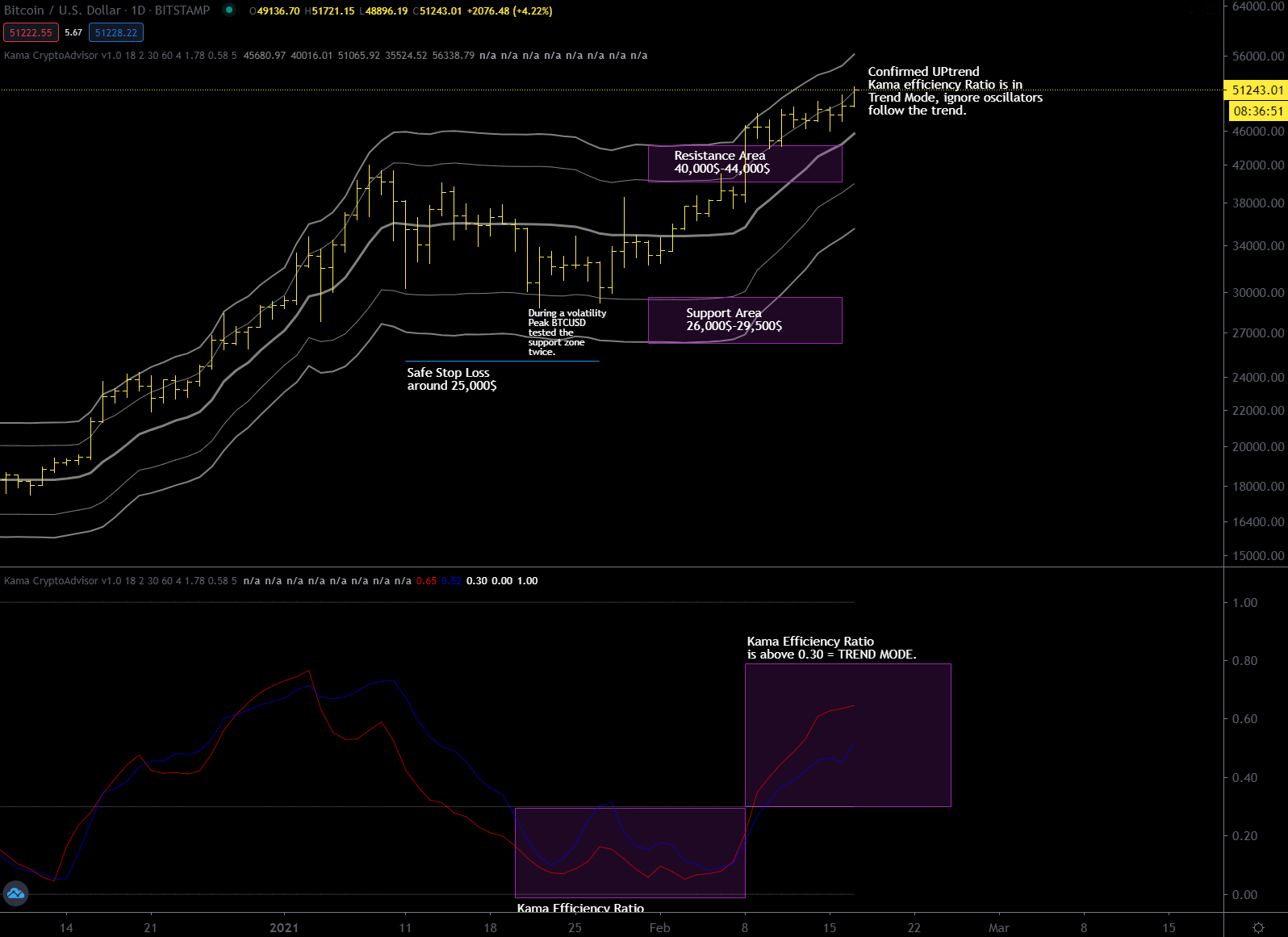
As I have said many times in the past, when the Kama average is flat there are very good resistance and support zones that define the useful space in which an asset, in this case bitcoin, moves.
Outside of these resistance zones a trend reversal is confirmed (if we break the support zone) or the continuation of the bullish trend (if we break the resistance zone).
What has happened is that bitcoin has broken the resistance zone positioned at 40-44 thousand dollars thus confirming the bullish trend. On the weekly chart the trend is strong and price remains consistently above the weekly Kama average.
Kama efficiency ratio is now in “Trend Mode” on all the main timeframes: Daily, Weekly, Monthly; therefore my outlook is strongly bullish.

Short Term Update: Approaching Resistance Area

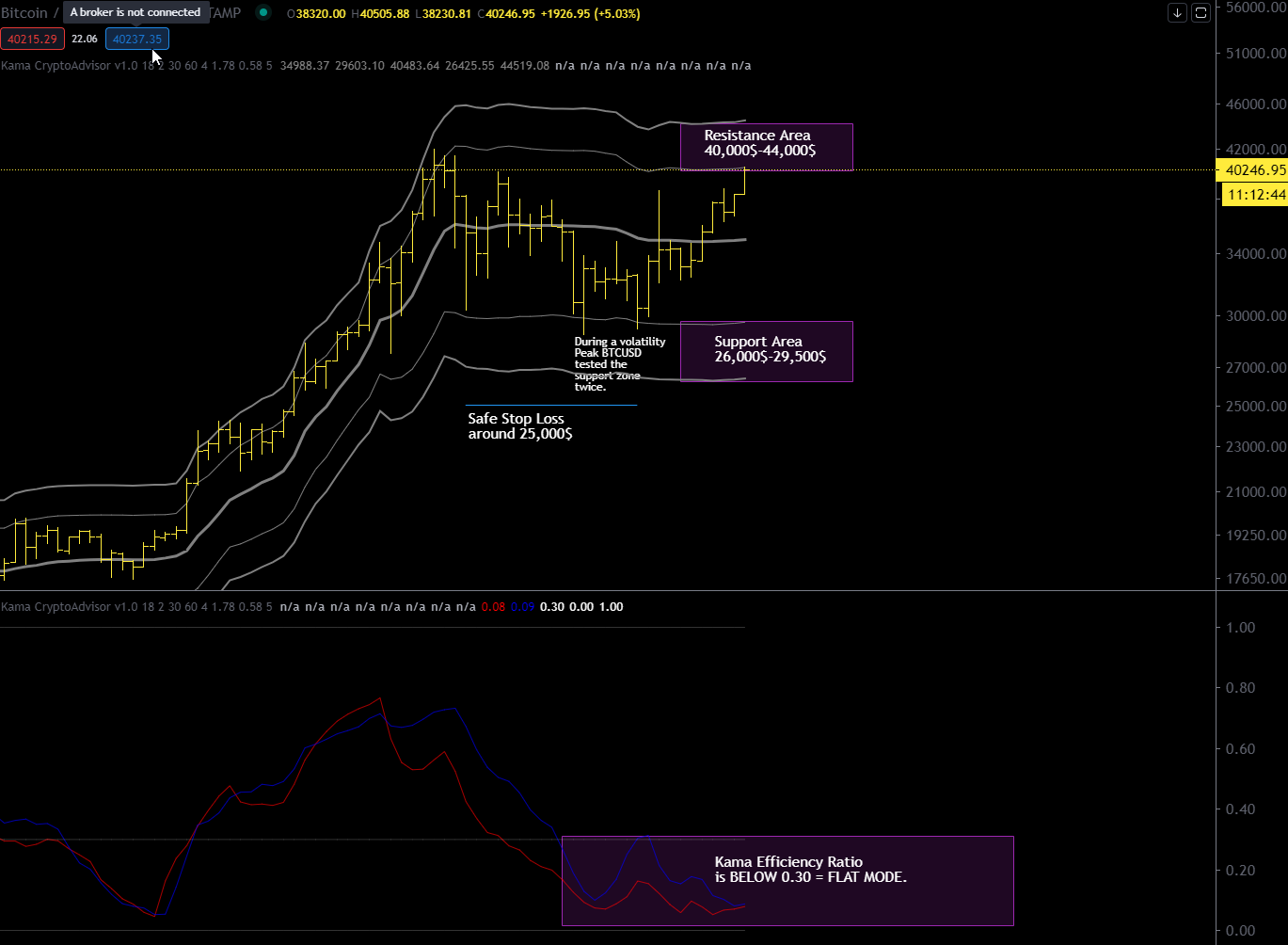
The situation has not changed much since the last update, BTCUSD retested the support zone a second time and reacted to the upside.
Now we are entering the resistance zone and the kama efficiency ratio is still below 0.30, flat market.
I would say that I’ll expect some form of resistance between 40 and 44k from sellers in general.
A decisive break above $44k would confirm the continuation of the ongoing bullish trend on the monthly chart.

BTCUSD Daily Chart – Kama average and bands + Kama Efficiency Ratio

A particular attention deserves the situation on the weekly chart, where instead of going down BTCUSD remained flat for 4 weeks, I would interpret this behavior as a signal of strength.
Honestly, looking at the weekly chart, I already see 53-54 thousand dollars as a target for the coming weeks.

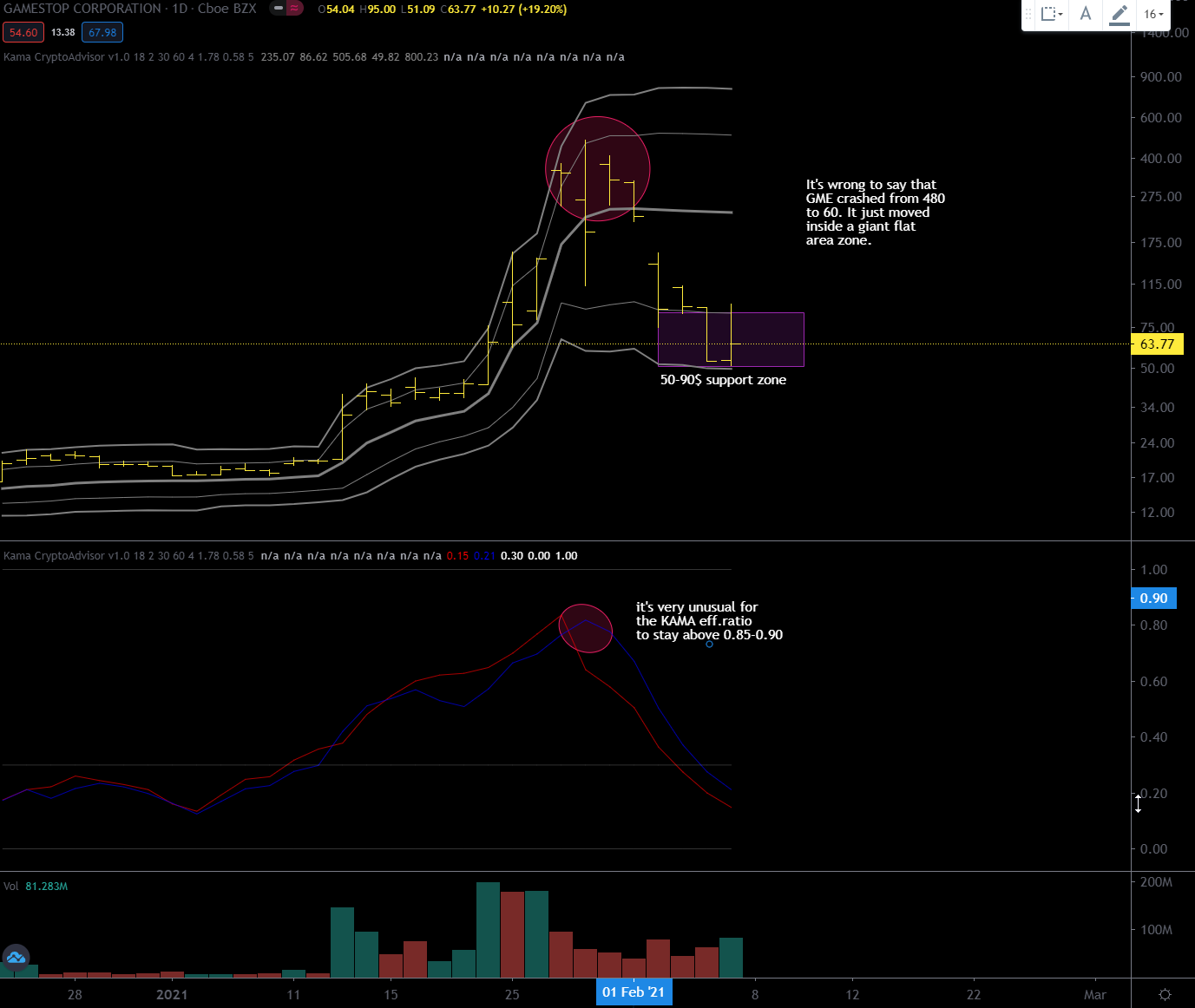
OFFTOPIC: A nice example of how to spot a top with Kama Efficiency Ratio

GME Daily Chart – Kama and Kama ER

I wanted to include this example because I think it is very good to understand the potential of the Kama average togheter with deviation bands and its efficiency rate (ER).
Last 28 January after a very volatile day and given the reading of over 0.80 of the kama ER I understood that something was wrong and that the top could have been done. This was confirmed in the following days.
A violent downward movement immediately brings the average kama in a stalemate position that allows us to have reliable deviation bands support/resistance zone.
I expected a correction down to 60 usd, which then happened. It is also not correct to say that the price collapsed from $480 to $60, it just moved within a very wide flat zone.
Now the GME price might even go back up to the Kama average.

Short Term Update: Daily Chart Quick Check!

Since the last daily update bitcoin has gone into “flat mode” (kama efficiency ratio below 0.30), in this mode you can expect the oscillators to work fairly well so that the widespread stochastic oscillator gave you a nice buy signal a few days ago.
I believe that today or tomorrow at the latest bitcoin is going to recover the Kama average at $35,900.
It remains to be seen in which direction the kama efficiency ratio will confirm the next trend on the daily chart considering that the situation on the weekly remains a bit unfavorable to the bullish while the monthly one is not, as I said in the previous long term update of January 19.

BTCUSD Daily Chart – Kama and Kama efficiency ratio, 18 periods.

Short Term Update: Flat mode or Trend mode?

I always tell you guys that it is very important to evaluate the relationship between trend strength and volatility, it makes us understand if the market is in “trend mode” or “flat mode”, at the moment we are at the limits, the market has reacted from the support shown in the last update but it is not enough.
In order to stay in “trend mode” it is now necessary to make a higher top than the previous one, perhaps around $46,000; any top lower then this would imply that BTCUSD is slowing down and going FLAT.

BTCUSD Daily Chart – Kama deviation bands and efficiency ratio on lower pane

When a security or an asset is in “trend mode” it is strategically optimal to keep the position in the direction of the trend without trying to go against by opening a short positions inside the deviation bands resistance area.
If you really want to go short, enhance the efficiency of your initial stop-loss by pairing it with a trailing stop loss.

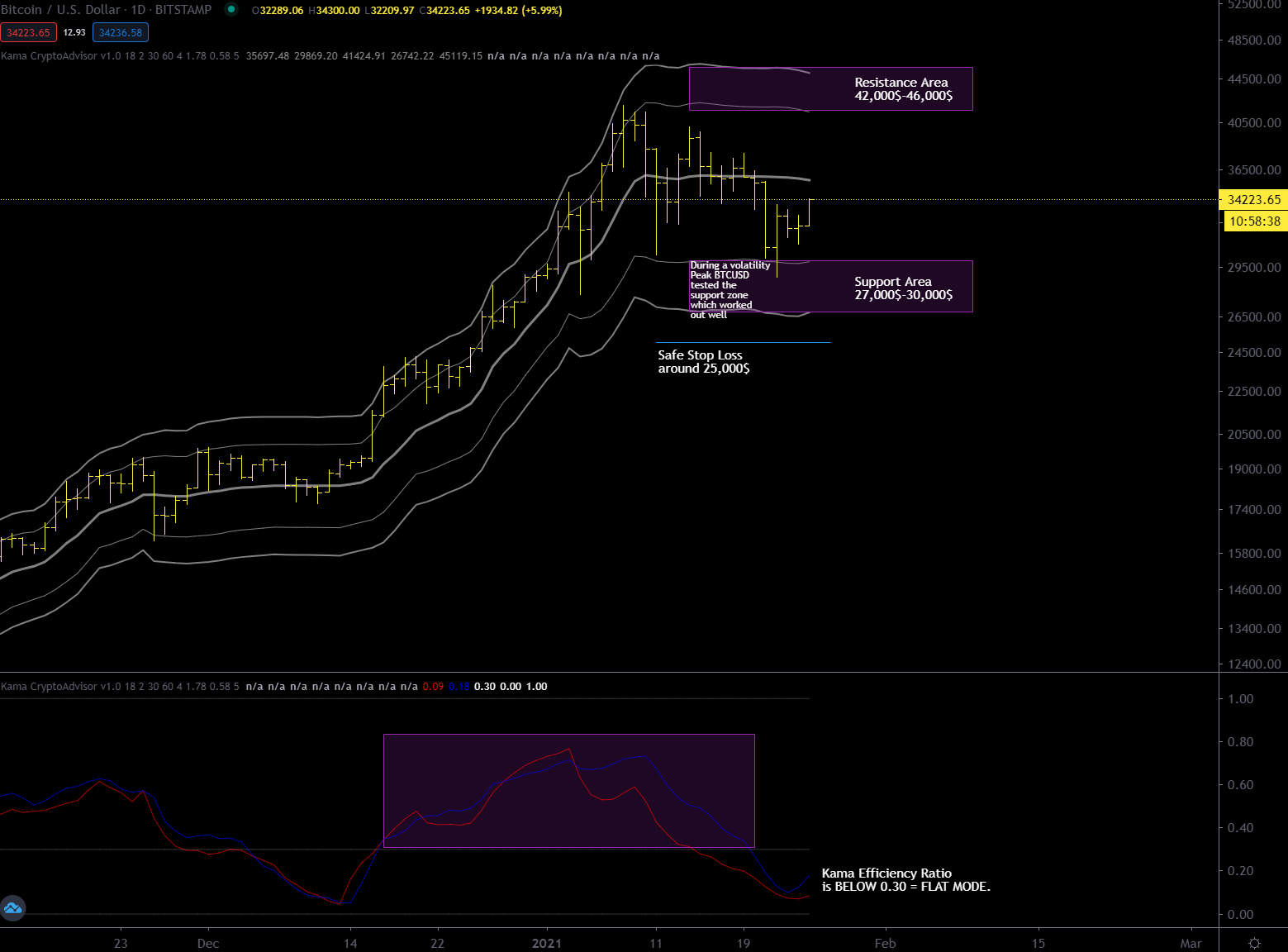
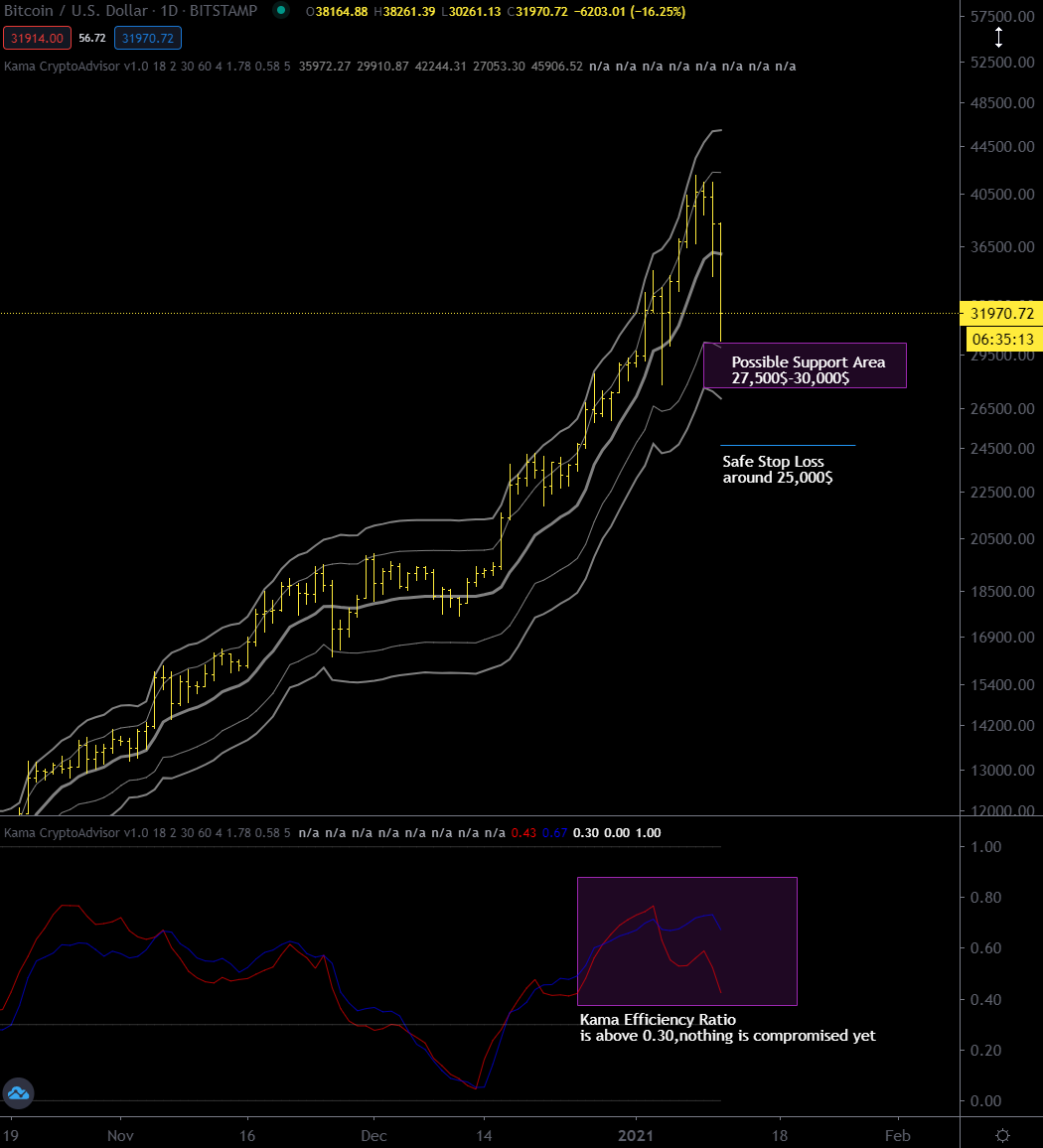
Short Term Update: at the limit!

I didn’t expect such an intense drop, as a general rule when volatility increases you have to go up with the timeframe used, the 4 hour chart is not enough anymore.
On the daily chart a correction below $30,000 would mean that an intermediary top has been made at $42,000 and that a more or less prolonged sideways movement awaits us before seeing new highs.
I am including below an updated daily chart.

Short Term Update: Sometimes simplicity is the answer

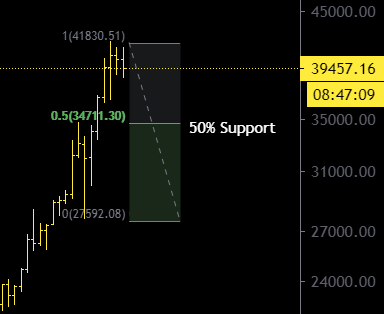
BTCUSD Daily Chart and 50% retracement support

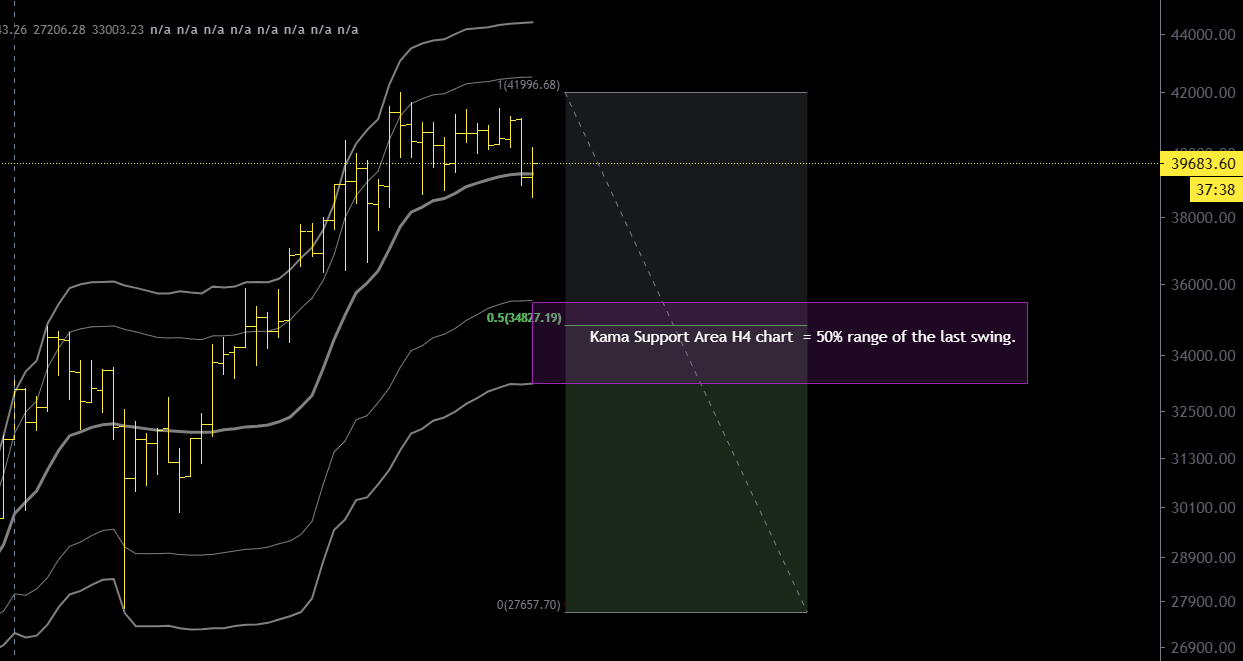
After a strong rise from $27,000 to $42,000 I think it is time for a break, in these situations sometimes the simplest approach is the valid one. The most obvious support is the 50% of the range at around 34,800$.

The closest dynamic support are the deviation bands of the kama average on the 4 hour timeframe.

I’m not saying that BTCUSD will go there, it could be an opportunity to buy if this scenario materializes. Don’t forget that when the market is fast you can lower the timeframe to find better support areas, as you can see in the above chart KAMA deviation bands worked well during the sell-off down to 27,000$ last January 4. Under these circumstances the daily chart is too slow to adapt.

You often ask me when to enter a trend already started, usually it is never too late to buy the important thing is to place a stop that is beyond the deviation bands that I use, to stay safe from volatility. Let’s see an example on the daily chart.

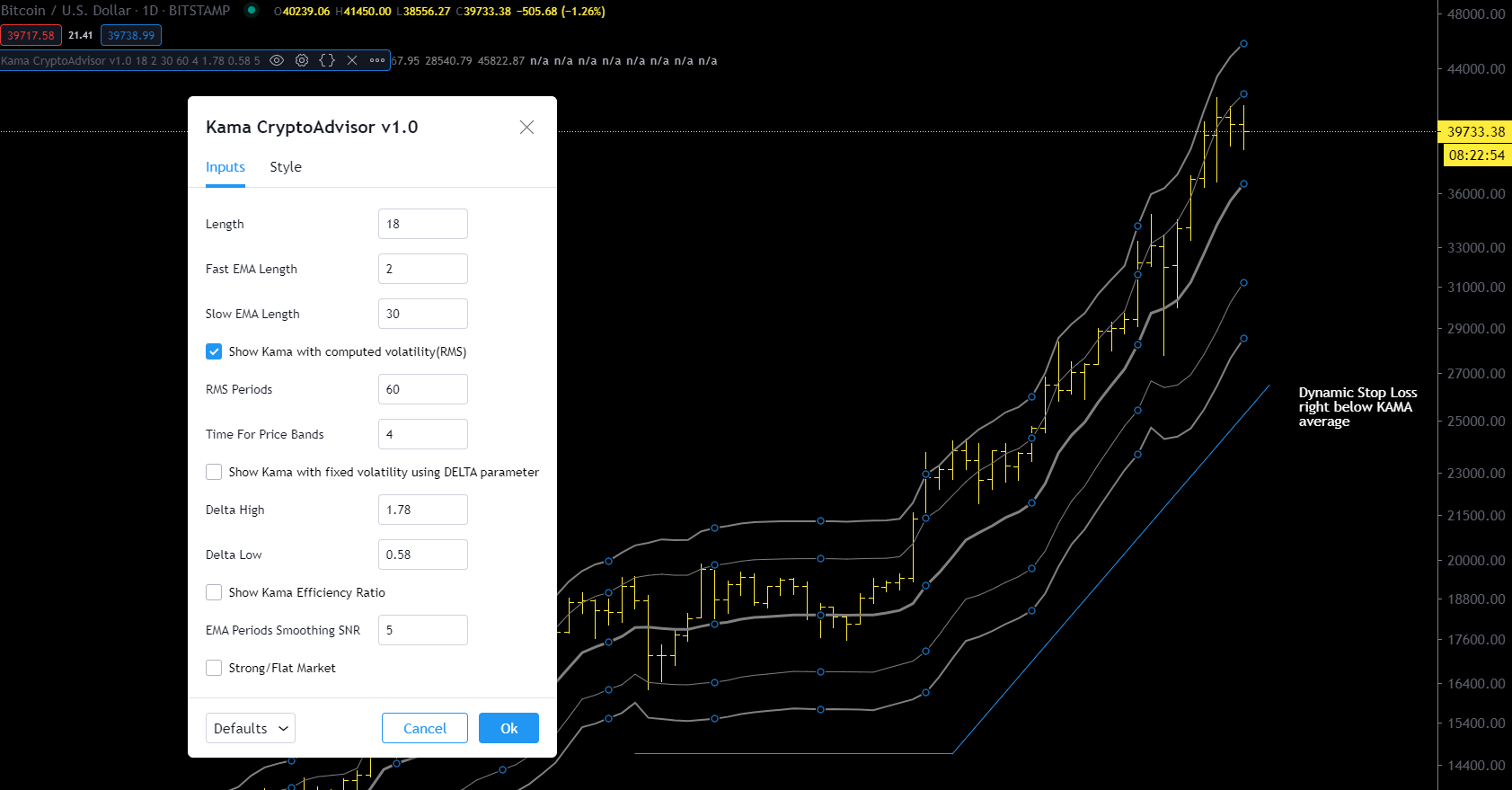
BTCUSD Daily Chart with kama average and an ideal dynamic stoploss – KAMA parameters that i use are included.

You can buy at any moment a well established trend but keep in mind that the right stoploss to use is wide, not tight because Bitcoin volatility is high.
If you don’t like KAMA average and the way i compute bands you can give a try to Keltner Channels.
Personally i prefer the approach of Mr.Kaufman but the choice is yours.

Long Term Update

BTCUSD Monthly Chart KAMA Average 5 periods and deviation lines.

Since the last update on February 13 there are not many new developments. The monthly KAMA average is flat, which allows us to calculate fairly reliable levels of support and resistance. As you can see nothing interesting happened with the BTCUSD cross that remains inside the supports and resistance levels (yellow lines).

I have added a new indicator that calculates supports and resistances using as a starting point the close of the previous month (with the idea to forecast next month support/resistance levels), in this case the close of February at about $ 10300. I have used the last 50 months, just over 4 years from the bear market’s lowest point in 2015, to calculate volatility.

The drop we have seen in recent days has reached an intermediate level, -1.5 standard deviations, so I can say that there has not been a level of extreme volatility but not even normal.

My opinion is that the bitcoin will continue to remain for most of the year within the levels calculated with the KAMA (yellow) and therefore remains a good opportunity to buy the price area from 4000 to 5500 dollars, while it is to be evaluated a reduction of any bullish position should the BTCUSD go above 25 thousand dollars.

I also give you some short term indications for the next days, the first resistance is $9500, you might see a Top not exceeding $9500 before the BTCUSD resumes its descent. A break above $10000 would mean that at least in the short term the bearish trend is over.


ITA Version here

Long Term Update: Bottom Done Yes or No?

On 18 January 2018, I wrote that the bottom was probably done but I hinted that at the break of the same I would have closed my long term position, unfortunately there was a subsequent very strong selling activity after a weak reaction from the support of the weekly chart (at about 9500$). In these cases it is useful to scale the time frame to the next one (from weekly to monthly), so i applied the KAMA average and its deviation lines to the monthly graph instead of applying them to the weekly graph.
The resulting graph is this at the moment and the market has reacted strongly from this support area.

monthly chart btcusd
BTCUSD Monthly Chart – Kama and deviation lines

You can see that the first deviation  line has hold the price from further lows at the end of the 2014-2015 bearish market, the same negative deviation line reported to date is at about $ 5300 and the market, for now, has done a bottom at $ 5900. I’ts difficult for me to say if the bearish market started in December 2017 is over, I remain convinced that we will hardly see stable prices under $3900 and that the support area from $3900 to $5300 will be very strong for this year.

If during ther year the trend of the Kama average becomes bearish from flat we will have a confirmation that a down trend, even on the monthly chart, has been established and this would undermine a little the validity of the support area indicated in the chart.
For now I think that the market is still stronger than the 2014-2015 period and that any medium-term correction should be above the indicated support area.

Italian version here.