Quantify the Euphoria: Top Model and the forecast to $250k

If the “Two-Phase Power Law” model defines the floor (Fair Value), a complementary equation defines the ceiling: the Peak Envelope.

To understand where price may go in this cycle, we must analyze two opposing dynamics that evolve over time:

  1. The deceleration of the rise (Slope Decay).
  2. The contraction of the bubble (Peak Envelope Decay).

1. The Mathematics of the Rise (Slope Decay)

One of the main flaws of fixed 4-year models is the assumption that every cycle is identical in time. The data show the exact opposite and the speed at which price rises from bottom to top is decreasing according to an inverse power law.

By analyzing past cycles, we obtain the following formula for the slope (rate of ascent in logarithmic terms):

Slope = 14.68 × n^(-2.17) decades/year

Where n is the cycle number.

CycleLength (days)True Slope (Dec/Year)Slope Model
22953.2913.267
37421.3581.356
410680.7040.727
510610.4590.448
6?~0.21 so far0.302

What does this mean? In 2013 (Cycle 3), the market was rising at a crazy speed (1.35 decades per year). For Cycle 6, the model predicts a slope of 0.302.

It is like saying: “The Ferrari has turned into a freight train. It is still powerful, but it takes much longer to reach its destination.”.

The “Slope” (velocity) in this model tells us how many powers of 10 the price rises by every year:

Slope 3.0 = Price multiplies by 1,000 every year.

Slope 1.0 = Price multiplies by 10 every year.

Slope 0.3 = Price doubles every year.

2. The Peak Envelope

While price rises more slowly, the bubble multiple (how far above Fair Value we are willing to pay) is collapsing.

  • In 2013 we paid 25× Fair Value.
  • In 2021 we paid about 7× Fair Value.
  • In this cycle the ceiling (Envelope) will fall even further to an expected value of 4.7x

We modeled this decay using an inverse logarithmic curve that connects historical peaks.

3. The ‘Self-Consistent’ Projection at ~$250k

Instead of guessing a date, I wrote an iterative algorithm (in Python) that searches for the geometric intersection between two forces:

  1. The Upward thrust: the line starting from the bottom ($16,500) with the Cycle 6 slope (0.302).
  2. The Ceiling: the Peak Envelope curve declining over time.

The point where these two lines collide is the cycle top. (check below images)

Model Result (Baseline):

  • Peak date window: from November 2026 to April 2027.
  • Price: ~$250,000
  • Multiple: about 4.7× above Fair Value at that time

This scenario represents historical continuity. A longer cycle than previous ones, extending beyond the usual 4-year pattern, allowing price to grow until the bubble multiplier stops it.
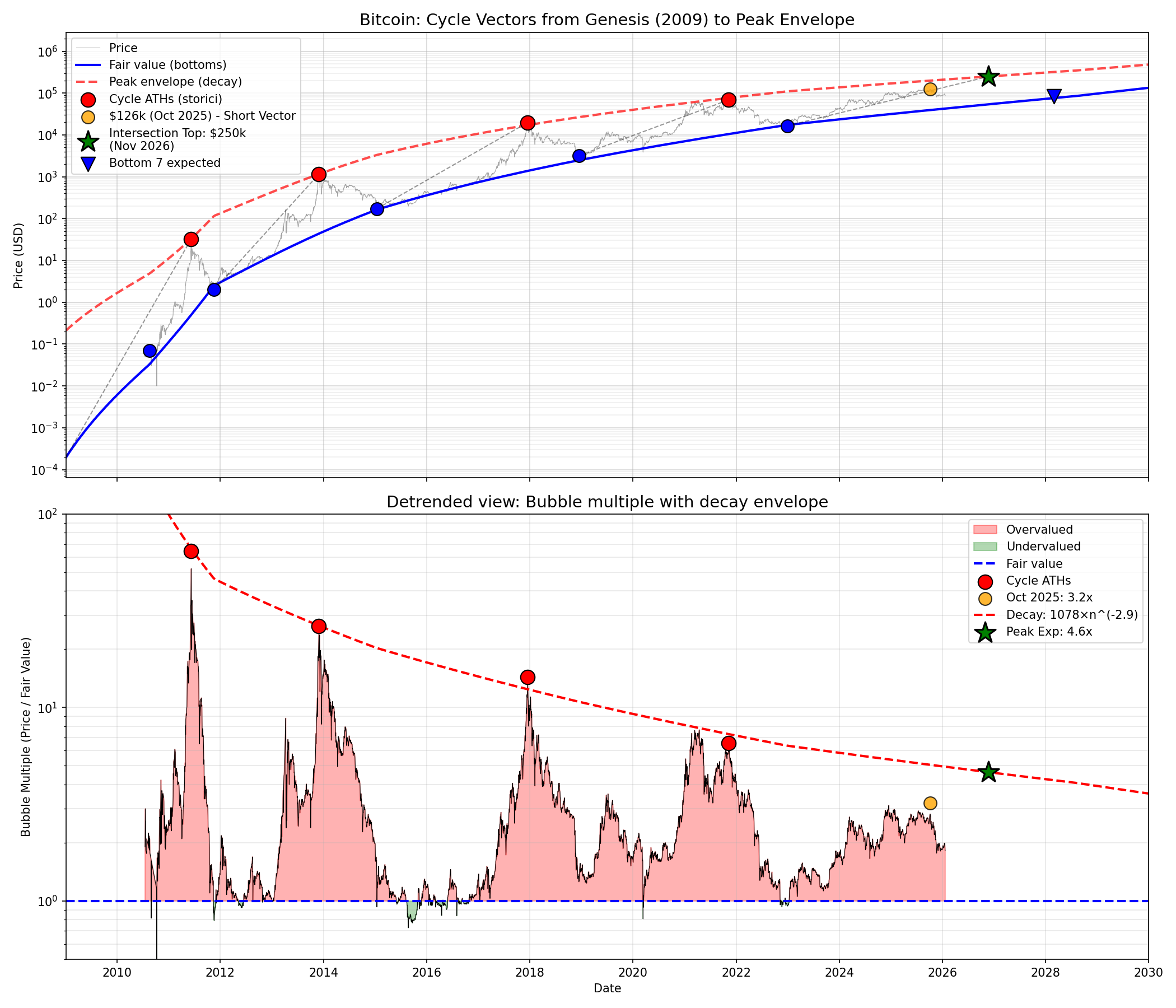
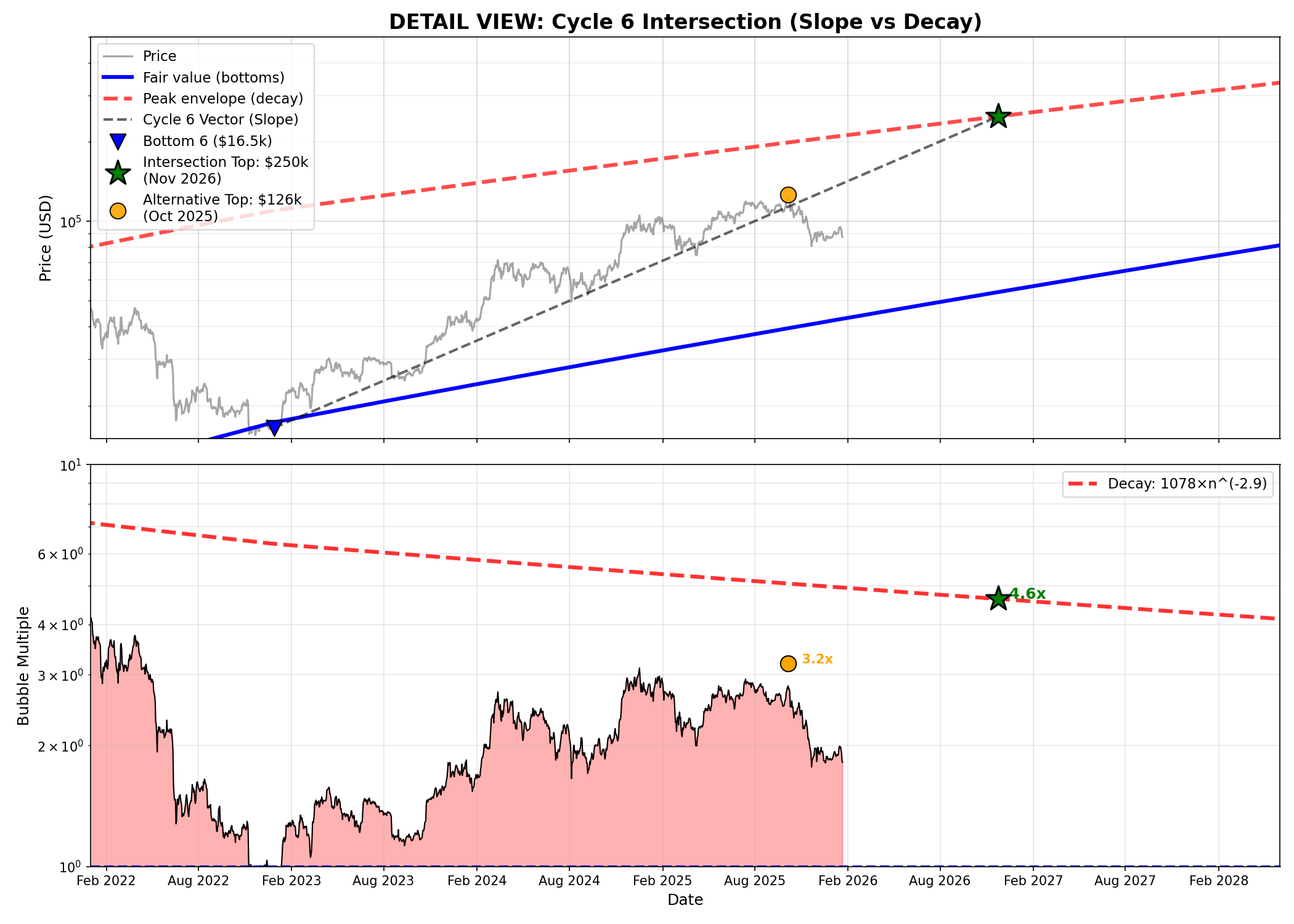
A November 2026 top may be optimistic, the date can shift to April 2027 due to slope uncertainty.

=== FIT ===
slope = 14.6835 × n^(-2.17) decades/year
Std residuals: 0.0242 decades/year

=== SLOPE Cycle 6 ===
Forecasted value: 0.302 decades/year
Error (1σ): ±0.024 decades/year
+1σ: 0.326 decades/year
-1σ: 0.278 decades/year

ScenarioSlope dec/year Top DateTop PriceBottom DateBottom Price
-1σ0.2782027-03-31$ ~250,0002029-01-24$84,770
Mid0.3022026-11-27$ ~250,0002028-07-31 $83,800
+1σ0.3262026-08-13$ ~250,0002028-03-02$76,000

4. Alternative Scenario: The ‘Short Top’ at $126k

The model is sensitive to volatility compression. If the peak envelope decays faster than the historical average, the intersection happens much earlier.

In this contraction scenario the top has already been done:

  • Peak date: 6 October 2025
  • Price: $126,000
  • Implication: the market would have become efficient too early. Bitcoin would behave like a mature asset, with short cycles and low multiples, eliminating extreme euphoria phases.

If the last October top at $126,000 is confirmed as top of cycle 7 then it’s very easy to compute date and price of the bottom, $54,000 by December 2026 (fair price of my 2 phases price model) resulting in a perfect 4 year cycle, 4 years between November 2022 bottom and December 2026.

Conclusion

The model establishes $250,000 by late 2026 (with a potential extension into early 2027) as the natural geometric output”. In this baseline scenario the cycle’s ascent perfectly intersects the historical ‘Peak Envelope,’ maintaining the balance between price momentum and the decay of bubble multiples.

Conversely, a peak at $126,000 in October 2025 would not invalidate the model, but would signal accelerated market saturation. This ‘short top’ scenario implies that the market is no longer willing to pay the excessive premiums of the past.
It effectively suggests that Bitcoin’s valuation will be capped at approximately 2x its intrinsic Fair Value during each boom-bust cycle. Such a move would mark the definitive transition from a hyper-volatile speculative instrument to a mature, low-volatility asset.
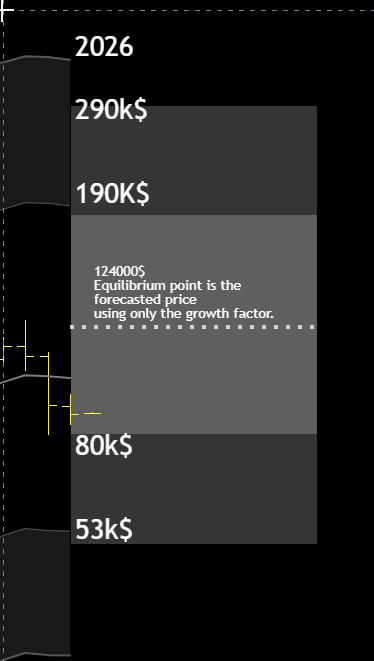
Long Term Update: 2026 Outlook with entropic methods

Every year i post an outlook using entropic methods explained in the technical section of this blog. Here you can find the 2015, 2016, 2017, 2018, 2019, 2020, 2021, 2022, 2023, 2024 and 2025 forecast update, where you can find more information about this approach.

Updated values for bitcoin (in brackets values of 2025) using daily data since August 2010 (from now on I will use only BITSTAMP data, as today there are not many differences between major Bitcoin exchanges.).

   BTC/USD
Growth Factor G 1.00094 (1.00099 )
Shannon Probability P (see this as entropy) 0.5217 (0.5295 )
Root mean square RMS (see this as volatility) 0.045 (0.047)

The entropy levels of Bitcoin against the USD showed no improvement in 2025. The Growth Factor (G) dropped a bit to 1.00094% daily compounded, equivalent to about 41% annually. The optimal portion of your total wealth to allocate to Bitcoin is now 4.3% (~0.5217*2=1.0434 – 1 = 0.0434 or ~4%) and it went down a bit due to a flat year.

“For those who may have forgotten, the Shannon Probability measures the persistence of Bitcoin’s price movement, indicating the likelihood that the asset will experience a positive trend. A value of 0.52 suggests that, out of 100 days, Bitcoin is likely to show an upward movement on 52 days, and either a decline or no significant movement on the remaining 48 days.”

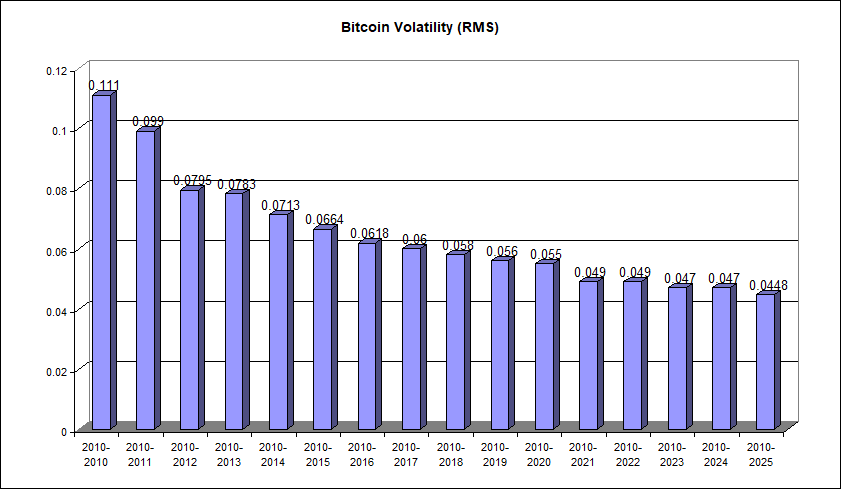
Bitcoin’s historical volatility dropped slightly this year, the only positive development amid otherwise challenging data, and aligns with expectations for a maturing asset in terms of capitalization. However, as noted in updates over the past two years, the pace of decline has slowed considerably, and volatility remains substantially higher than that of other assets, underscoring Bitcoin’s persistent nature as a highly speculative investment.

 
 2026 Price forecast  Full Historical Volatility  Half Historical Volatility
Forecast using only G* or Growth Factor ~124,000$ ~124,000$
Upper bound adding volatility ~292,000$ ~190,500$
Lower bound subtracting volatility ~52,700$ ~80,800$

*124,100 $ is obtained with 1st January as a starting price (around 87890$) times (1.00094^365)=~1.41   |  87890*1.41=~124000$, just change 365 with the number of days you prefer for a different forecast.

What happened in 2025? 

In this 2025 this market went up but failed to break through the equilibrium point that I calculate every year in January, which was set at around $132,000. The market corrected down to the annual support calculated with half historical volatility at about $85,000. As shown for those who follow me on Twitter, there were also weekly supports from my deviation bands at around $83,000. Considering that the updated forecast for 2026 still includes $80,800 as support, the area between 80 and 90 thousand dollars remains an interesting support zone.

I was hoping for something better this year, at least a quick visit above $132,000, but that didn’t happen. For this year, the directional bias remains unclear, though key levels are well-defined., but the support zone at around $53,000 remains very interesting, it’s both the last level of this year’s forecast and also a support from my monthly deviation bands calculated from the KAMA average. I refer you to my latest post on Twitter.

Conclusions

After holding my long position for nearly three years, initiated in February 2023 at approximately $22,500, this is a good moment to reassess the risk/reward profile at current levels.

The 2025 data tells a nuanced story, while Bitcoin delivered positive returns, the entropic indicators showed marginal deterioration. The Growth Factor declined and Shannon Probability dropped , these aren’t alarm signals, but they suggest that the statistical edge has weakened a bit compared to when I entered the position.

At current prices around $88,000, I’m sitting on roughly 290% gains. My approach for 2026 is conditional.

If $80,000 breaks down decisively, I will take profits. This level represents both the lower bound of my half-volatility forecast and a psychologically significant threshold. Even at $80k, I’d be locking in approximately 255% gains, a reasonable exit after a historically strong run.

My reentry target would be the $50,000–55,000 zone. This area aligns with both the full-volatility lower bound at $52,700 and my monthly KAMA deviation bands. 

On the other hand, if $132,000 breaks to the upside, I will hold and reassess at the upper bound levels. This is not a bearish call, it’s risk management after a successful multi-year trade. The data doesn’t justify aggressive positioning in either direction at these levels.

Feel free to reach out with any questions, and I’ll see you in the next update. Happy New Year!

Charts

Bitcoin’s cumulative volatility follows a compelling logarithmic decay curve, at the current trajectory, convergence with typical US equity volatility levels is still 15 to 20 years out. A reminder that, as an asset class, Bitcoin remains in its infancy.
Projected levels for 2026
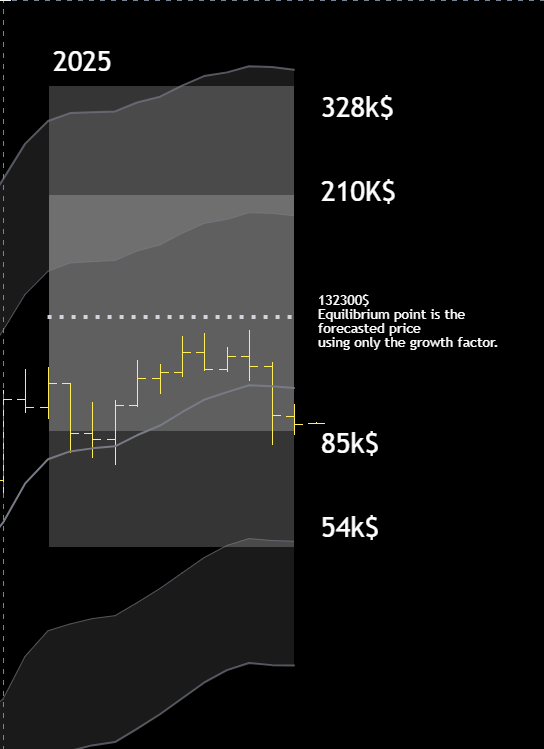
Here’s what happened in 2025, where the market failed to move above the equilibrium point calculated using only the Growth Factor (G).

Long Term Update: 2025 Outlook with entropic methods

Every year i post an outlook using entropic methods explained in the technical section of this blog. Here you can find the 2015, 2016, 2017, 2018, 2019, 2020, 2021, 2022, 2023 and 2024 forecast update, where you can find more information about this approach.

Updated values for bitcoin (in brackets values of 2024) using daily data since August 2010 (from now on I will use only BITSTAMP data, as today there are not many differences between major Bitcoin exchanges.).

   BTC/USD
Growth Factor G 1.00099 (1.00099 )
Shannon Probability P (see this as entropy) 0.5295 (0.5224 )
Root mean square RMS (see this as volatility) 0.047 (0.047)

The entropy levels of Bitcoin against the USD showed no significant improvement in 2024. The Growth Factor (G) remained steady at 1.00099% daily compounded, equivalent to about 44% annually. The optimal portion of your total wealth to allocate to Bitcoin increased to 6% (~0.5295*2=1.0448 – 1 = 0.059 or ~6%), driven by a year-long upward trend in Bitcoin’s price, which boosted the Shannon Probability from 0.522 to nearly 0.53, an improvement, but still modest.

“For those who may have forgotten, the Shannon Probability measures the persistence of Bitcoin’s price movement, indicating the likelihood that the asset will experience a positive trend. A value of 0.53 suggests that, out of 100 days, Bitcoin is likely to show an upward movement on 53 days, and either a decline or no significant movement on the remaining 47 days.”

Bitcoin’s historical volatility has remained relatively unchanged this year, aligning with the average recorded since the inception of its historical data in August 2010. Currently, it remains stable at a comparatively high level, particularly when measured against traditional assets such as gold, stocks, bonds, and forex currencies, refer to the chart at the end of this post for more details.

As i said in my last year update it seems that a volatility plateau has been identified, and it is notably substantial higher compared to other assets. This suggests that Bitcoin continues to be a highly speculative asset as its volatility is still too high to be considered a viable reserve asset for central banks, despite increasing recent discussions around its potential in this role. 

 2025 Price forecast  Full Historical Volatility  Half Historical Volatility
Forecast using only G* or Growth Factor ~132,300$ ~132,300$
Upper bound adding volatility ~328,000$ ~209,300$
Lower bound subtracting volatility ~52,300$ ~85,100$

*132,300$ is obtained with 1st January as a starting price (around 91900$) times (1.00099^365)=~1.44   |  91900*1.44=~132300$, just change 365 with the number of days you prefer for a different forecast.

What happened in 2024? 

A year ago, I predicted an upper boundary of $151,000 using full historical volatility and approximately $96,000 using half of that volatility. These targets were calculated based on the opening price on January 1, 2024, which was around $44,000. The calculated support levels were $24,900 and $39,000.

The year turned out to be overwhelmingly positive, with Bitcoin surpassing the initial calculated resistance of $96,000. This reflects notable strength in the uptrend, as BTCUSD reached an all-time high of $108,300 in December. The most probable resistance level of $96,000 held true, as the year-end price stayed below it, which aligns with expectations.

Looking ahead to 2025, I will focus on levels calculated using reduced volatility (half the historical value) since this approach often yields more reliable results. This gives us a key support level at $85,000, which is highly significant. If Bitcoin spends too much time below $85,000 during 2025, it may signal the end of the uptrend that began from the $16,000 low in 2022.

In a bearish scenario, should it materialize, I would anticipate a potential low in the $50,000 range during 2025.

Conversely, if Bitcoin holds consistently above $85,000, the first major resistance to watch is around $210,000. This could mark the end of the current uptrend that started in 2022 and would represent a strong peak. Any value exceeding $210,000 should be considered a clear speculative bubble. I do not expect the upper limit of $328,000 to be breached throughout 2025.

Conclusions

For this year, I may consider taking profits on my position if the market shows signs of weakness below the critical $85,000 level. As a reminder, I initiated my bullish position in February 2023 at approximately $22,500.

I also recommend cautious long-term trading strategies this year. The growing speculation around Bitcoin as a potential reserve asset for central banks could lead to a spectacular market top. In that scenario, preliminary support levels for 2026, calculated using a starting price of $91,900 on January 1, 2024, and a two-year window, suggest potential declines between $54,000 and $100,000. If Bitcoin reaches a significant top, potentially at or above $200,000, these levels become plausible targets for a subsequent correction in 2026. These values are provided as a preview to illustrate possible directions, but only if such a dramatic peak occurs this year.

That said, I remain firmly confident in the $85,000 support level as a key indicator of the current uptrend’s strength. Regardless of the various scenarios discussed, keep this level in mind as your primary reference point.

As for the upper boundary, I believe it is highly improbable to reach or surpass $328,000 during 2025.

Feel free to reach out with any questions, and I’ll see you in the next update. Happy New Year!

Charts

Bitcoin’s cumulative volatility as expected is dropping every year and is stabilizing towards a value that is still a bit high compared to other traditional assets (stocks, gold, bonds range from 0.01 to 0.03) but the very high average returns of btc compensate the high volatility. The values represent the root mean square of logarithmic returns of bitcoin daily data.
Projected levels for 2025
Here’s what happened in 2024, where the market spent a lot of time around the equilibrium point calculated using only the Growth Factor (G).

Long Term Update: 2024 Outlook with entropic methods

Every year i post an outlook using entropic methods explained in the technical section of this blog. Here you can find the 2015, 2016, 2017, 2018, 2019, 2020, 2021, 2022 and 2023 forecast update, where you can find more information about this approach.

Updated values for bitcoin (in brackets values of 2023) using daily data since August 2010 (from now on I will use only BITSTAMP data, as today there are not many differences between major Bitcoin exchanges.).

   BTC/USD
Growth Factor G 1.00099 (1.00090 )
Shannon Probability P (see this as entropy) 0.52237 (0.5214 )
Root mean square RMS (see this as volatility) 0.0471 (0.049)

The entropy values of Bitcoin versus the USD have experienced a slight improvement in 2023. The Growth Factor (G) has marginally risen to 1.00099% compounded daily or 144% per year, surpassing the 139% observed one year ago. The optimal fraction of your total wealth to invest in Bitcoin has also slightly elevated to 4.5% (~0.52237*2=1.04475 – 1 = 0.04475 or ~4.5%), a figure that can still be rounded to 5%, similar to last year’s recommendation.

The volatility of Bitcoin has not exhibited an increase this year, considering the average value since the inception of its historical series in August 2010. Currently, it maintains a stable position at a relatively high value when compared to other assets such as gold, stocks, bonds, and forex currencies.

It seems that a volatility plateau has been identified, and it is notably substantial higher compared to other assets. This suggests that Bitcoin continues to be a highly speculative asset. In the year 2023, the growth factor of BTCUSD still outperforms traditional markets significantly, except for the Shannon Probability, which aligns closely with that of the US stock market (around 0.52). This implies that, on average, out of 100 days, an asset rises for 52 days and declines for 48 days.

 2024 Price forecast  Full Historical Volatility  Half Historical Volatility
Forecast using only G* or Growth Factor ~61,400$ ~61,400$
Upper bound adding volatility ~151,000$ ~96,000$
Lower bound subtracting volatility ~24,900$ ~39,000$

*61400 is obtained with 1st January as a starting price (around 42650$) times (1.00099^365)=~1.44   |  42650*1.44=~61400$, just change 365 with the number of days you prefer for a different forecast.

What happened in 2023? 

A year ago, I predicted an upper boundary of $58,000 using full volatility and about $36,500 using half of historical volatility, these two targets were calculated based on the opening price on January 1, 2023, which was around $16,500. The calculated support levels were $9,100 and $14,500. 
The year has proven positive, surpassing the initial calculated resistance level of $36,500, which coincided with the monthly KAMA average. This signals a notable strength in the uptrend, with BTCUSD transitioning from a position of weakness to one of strength by rising above the monthly average.

Conclusions

For this year, it might be a smart move to also consider a lower value for volatility, let’s say 25% of the historical volatility, as I don’t expect a new all-time high but rather a consolidation phase a few months before, during, and after the halving. Therefore, determining a resistance level at around $77,000, calculated with a precise 1/4 of historical volatility—a method I don’t typically employ but find plausible for this year. This is due to my belief that it might be challenging for the volatility to remain high for a significant amount of time, making it less likely for BTC to surpass this $77,000 level.

I might consider taking profit if the market shows signs of weakness around this level. I remind you guys that I had opened a bullish position in February 2023 at approximately $22,500.

Furthermore, I have cautious long-term trading recommendations for you this year. The hype surrounding ETFs might culminate in a “sell on news” scenario on the day the ETF gets approved. There’s a possibility of subsequent gradual declines in Bitcoin prices toward calculated support levels for the next year, ranging between $24,000 and $39,000. Don’t forget that the most probable support area is around the monthly Kama, which is inside the support windows for this year ($24,900-$39,000).

Instead of anticipating any catastrophic scenarios this year, in contrast to the previous year, which appeared more susceptible to bearish scenarios, I maintain my view of the $24,900 support as very solid.

About the upper bound i’ve to admit that it is very unlikely to reach and/or break $151,000 during 2024.

I’m at your disposal for any questions; see you at the next update and Happy New Year!

Charts

Bitcoin’s cumulative volatility as expected is dropping every year and is stabilizing towards a value that is still a bit high compared to other traditional assets (stocks, gold, bonds range from 0.01 to 0.03) but the very high average returns of btc compensate the high volatility. The values represent the root mean square of logarithmic returns of bitcoin daily data.
The first lower monthly kama average price band will probably slowly reach the $25,000 support level during the 2023.
I’ve added the equilibrium point computed using the G growth factor at $61,400.
The chart is monthly and begins at the end of November ’22 bottom.