Long Term Update: 2026 Outlook with entropic methods

Every year i post an outlook using entropic methods explained in the technical section of this blog. Here you can find the 2015, 2016, 2017, 2018, 2019, 2020, 2021, 2022, 2023, 2024 and 2025 forecast update, where you can find more information about this approach.

Updated values for bitcoin (in brackets values of 2025) using daily data since August 2010 (from now on I will use only BITSTAMP data, as today there are not many differences between major Bitcoin exchanges.).

   BTC/USD
Growth Factor G 1.00094 (1.00099 )
Shannon Probability P (see this as entropy) 0.5217 (0.5295 )
Root mean square RMS (see this as volatility) 0.045 (0.047)

The entropy levels of Bitcoin against the USD showed no improvement in 2025. The Growth Factor (G) dropped a bit to 1.00094% daily compounded, equivalent to about 41% annually. The optimal portion of your total wealth to allocate to Bitcoin is now 4.3% (~0.5217*2=1.0434 – 1 = 0.0434 or ~4%) and it went down a bit due to a flat year.

“For those who may have forgotten, the Shannon Probability measures the persistence of Bitcoin’s price movement, indicating the likelihood that the asset will experience a positive trend. A value of 0.52 suggests that, out of 100 days, Bitcoin is likely to show an upward movement on 52 days, and either a decline or no significant movement on the remaining 48 days.”

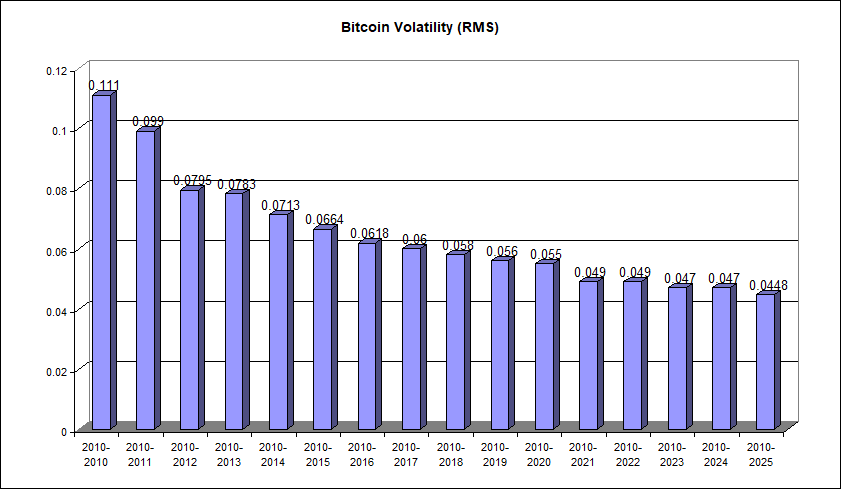
Bitcoin’s historical volatility dropped slightly this year, the only positive development amid otherwise challenging data, and aligns with expectations for a maturing asset in terms of capitalization. However, as noted in updates over the past two years, the pace of decline has slowed considerably, and volatility remains substantially higher than that of other assets, underscoring Bitcoin’s persistent nature as a highly speculative investment.

 
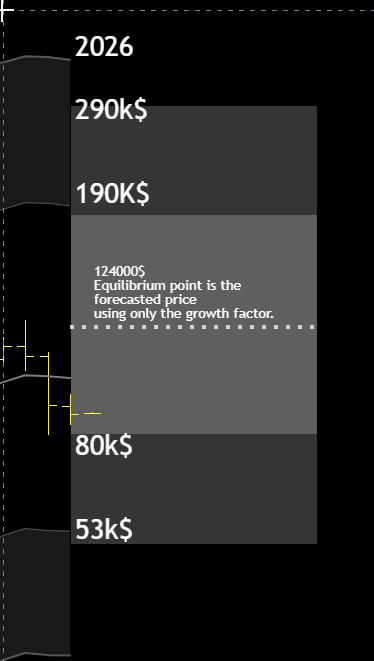
 2026 Price forecast  Full Historical Volatility  Half Historical Volatility
Forecast using only G* or Growth Factor ~124,000$ ~124,000$
Upper bound adding volatility ~292,000$ ~190,500$
Lower bound subtracting volatility ~52,700$ ~80,800$

*124,100 $ is obtained with 1st January as a starting price (around 87890$) times (1.00094^365)=~1.41   |  87890*1.41=~124000$, just change 365 with the number of days you prefer for a different forecast.

What happened in 2025? 

In this 2025 this market went up but failed to break through the equilibrium point that I calculate every year in January, which was set at around $132,000. The market corrected down to the annual support calculated with half historical volatility at about $85,000. As shown for those who follow me on Twitter, there were also weekly supports from my deviation bands at around $83,000. Considering that the updated forecast for 2026 still includes $80,800 as support, the area between 80 and 90 thousand dollars remains an interesting support zone.

I was hoping for something better this year, at least a quick visit above $132,000, but that didn’t happen. For this year, the directional bias remains unclear, though key levels are well-defined., but the support zone at around $53,000 remains very interesting, it’s both the last level of this year’s forecast and also a support from my monthly deviation bands calculated from the KAMA average. I refer you to my latest post on Twitter.

Conclusions

After holding my long position for nearly three years, initiated in February 2023 at approximately $22,500, this is a good moment to reassess the risk/reward profile at current levels.

The 2025 data tells a nuanced story, while Bitcoin delivered positive returns, the entropic indicators showed marginal deterioration. The Growth Factor declined and Shannon Probability dropped , these aren’t alarm signals, but they suggest that the statistical edge has weakened a bit compared to when I entered the position.

At current prices around $88,000, I’m sitting on roughly 290% gains. My approach for 2026 is conditional.

If $80,000 breaks down decisively, I will take profits. This level represents both the lower bound of my half-volatility forecast and a psychologically significant threshold. Even at $80k, I’d be locking in approximately 255% gains, a reasonable exit after a historically strong run.

My reentry target would be the $50,000–55,000 zone. This area aligns with both the full-volatility lower bound at $52,700 and my monthly KAMA deviation bands. 

On the other hand, if $132,000 breaks to the upside, I will hold and reassess at the upper bound levels. This is not a bearish call, it’s risk management after a successful multi-year trade. The data doesn’t justify aggressive positioning in either direction at these levels.

Feel free to reach out with any questions, and I’ll see you in the next update. Happy New Year!

Charts

Bitcoin’s cumulative volatility follows a compelling logarithmic decay curve, at the current trajectory, convergence with typical US equity volatility levels is still 15 to 20 years out. A reminder that, as an asset class, Bitcoin remains in its infancy.
Projected levels for 2026
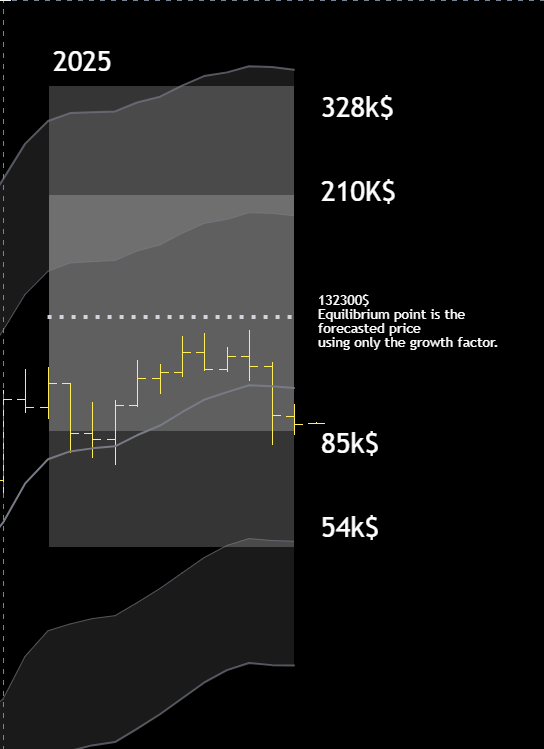
Here’s what happened in 2025, where the market failed to move above the equilibrium point calculated using only the Growth Factor (G).

Long Term Update: 2025 Outlook with entropic methods

Every year i post an outlook using entropic methods explained in the technical section of this blog. Here you can find the 2015, 2016, 2017, 2018, 2019, 2020, 2021, 2022, 2023 and 2024 forecast update, where you can find more information about this approach.

Updated values for bitcoin (in brackets values of 2024) using daily data since August 2010 (from now on I will use only BITSTAMP data, as today there are not many differences between major Bitcoin exchanges.).

   BTC/USD
Growth Factor G 1.00099 (1.00099 )
Shannon Probability P (see this as entropy) 0.5295 (0.5224 )
Root mean square RMS (see this as volatility) 0.047 (0.047)

The entropy levels of Bitcoin against the USD showed no significant improvement in 2024. The Growth Factor (G) remained steady at 1.00099% daily compounded, equivalent to about 44% annually. The optimal portion of your total wealth to allocate to Bitcoin increased to 6% (~0.5295*2=1.0448 – 1 = 0.059 or ~6%), driven by a year-long upward trend in Bitcoin’s price, which boosted the Shannon Probability from 0.522 to nearly 0.53, an improvement, but still modest.

“For those who may have forgotten, the Shannon Probability measures the persistence of Bitcoin’s price movement, indicating the likelihood that the asset will experience a positive trend. A value of 0.53 suggests that, out of 100 days, Bitcoin is likely to show an upward movement on 53 days, and either a decline or no significant movement on the remaining 47 days.”

Bitcoin’s historical volatility has remained relatively unchanged this year, aligning with the average recorded since the inception of its historical data in August 2010. Currently, it remains stable at a comparatively high level, particularly when measured against traditional assets such as gold, stocks, bonds, and forex currencies, refer to the chart at the end of this post for more details.

As i said in my last year update it seems that a volatility plateau has been identified, and it is notably substantial higher compared to other assets. This suggests that Bitcoin continues to be a highly speculative asset as its volatility is still too high to be considered a viable reserve asset for central banks, despite increasing recent discussions around its potential in this role. 

 2025 Price forecast  Full Historical Volatility  Half Historical Volatility
Forecast using only G* or Growth Factor ~132,300$ ~132,300$
Upper bound adding volatility ~328,000$ ~209,300$
Lower bound subtracting volatility ~52,300$ ~85,100$

*132,300$ is obtained with 1st January as a starting price (around 91900$) times (1.00099^365)=~1.44   |  91900*1.44=~132300$, just change 365 with the number of days you prefer for a different forecast.

What happened in 2024? 

A year ago, I predicted an upper boundary of $151,000 using full historical volatility and approximately $96,000 using half of that volatility. These targets were calculated based on the opening price on January 1, 2024, which was around $44,000. The calculated support levels were $24,900 and $39,000.

The year turned out to be overwhelmingly positive, with Bitcoin surpassing the initial calculated resistance of $96,000. This reflects notable strength in the uptrend, as BTCUSD reached an all-time high of $108,300 in December. The most probable resistance level of $96,000 held true, as the year-end price stayed below it, which aligns with expectations.

Looking ahead to 2025, I will focus on levels calculated using reduced volatility (half the historical value) since this approach often yields more reliable results. This gives us a key support level at $85,000, which is highly significant. If Bitcoin spends too much time below $85,000 during 2025, it may signal the end of the uptrend that began from the $16,000 low in 2022.

In a bearish scenario, should it materialize, I would anticipate a potential low in the $50,000 range during 2025.

Conversely, if Bitcoin holds consistently above $85,000, the first major resistance to watch is around $210,000. This could mark the end of the current uptrend that started in 2022 and would represent a strong peak. Any value exceeding $210,000 should be considered a clear speculative bubble. I do not expect the upper limit of $328,000 to be breached throughout 2025.

Conclusions

For this year, I may consider taking profits on my position if the market shows signs of weakness below the critical $85,000 level. As a reminder, I initiated my bullish position in February 2023 at approximately $22,500.

I also recommend cautious long-term trading strategies this year. The growing speculation around Bitcoin as a potential reserve asset for central banks could lead to a spectacular market top. In that scenario, preliminary support levels for 2026, calculated using a starting price of $91,900 on January 1, 2024, and a two-year window, suggest potential declines between $54,000 and $100,000. If Bitcoin reaches a significant top, potentially at or above $200,000, these levels become plausible targets for a subsequent correction in 2026. These values are provided as a preview to illustrate possible directions, but only if such a dramatic peak occurs this year.

That said, I remain firmly confident in the $85,000 support level as a key indicator of the current uptrend’s strength. Regardless of the various scenarios discussed, keep this level in mind as your primary reference point.

As for the upper boundary, I believe it is highly improbable to reach or surpass $328,000 during 2025.

Feel free to reach out with any questions, and I’ll see you in the next update. Happy New Year!

Charts

Bitcoin’s cumulative volatility as expected is dropping every year and is stabilizing towards a value that is still a bit high compared to other traditional assets (stocks, gold, bonds range from 0.01 to 0.03) but the very high average returns of btc compensate the high volatility. The values represent the root mean square of logarithmic returns of bitcoin daily data.
Projected levels for 2025
Here’s what happened in 2024, where the market spent a lot of time around the equilibrium point calculated using only the Growth Factor (G).

Long Term Update: 2024 Outlook with entropic methods

Every year i post an outlook using entropic methods explained in the technical section of this blog. Here you can find the 2015, 2016, 2017, 2018, 2019, 2020, 2021, 2022 and 2023 forecast update, where you can find more information about this approach.

Updated values for bitcoin (in brackets values of 2023) using daily data since August 2010 (from now on I will use only BITSTAMP data, as today there are not many differences between major Bitcoin exchanges.).

   BTC/USD
Growth Factor G 1.00099 (1.00090 )
Shannon Probability P (see this as entropy) 0.52237 (0.5214 )
Root mean square RMS (see this as volatility) 0.0471 (0.049)

The entropy values of Bitcoin versus the USD have experienced a slight improvement in 2023. The Growth Factor (G) has marginally risen to 1.00099% compounded daily or 144% per year, surpassing the 139% observed one year ago. The optimal fraction of your total wealth to invest in Bitcoin has also slightly elevated to 4.5% (~0.52237*2=1.04475 – 1 = 0.04475 or ~4.5%), a figure that can still be rounded to 5%, similar to last year’s recommendation.

The volatility of Bitcoin has not exhibited an increase this year, considering the average value since the inception of its historical series in August 2010. Currently, it maintains a stable position at a relatively high value when compared to other assets such as gold, stocks, bonds, and forex currencies.

It seems that a volatility plateau has been identified, and it is notably substantial higher compared to other assets. This suggests that Bitcoin continues to be a highly speculative asset. In the year 2023, the growth factor of BTCUSD still outperforms traditional markets significantly, except for the Shannon Probability, which aligns closely with that of the US stock market (around 0.52). This implies that, on average, out of 100 days, an asset rises for 52 days and declines for 48 days.

 2024 Price forecast  Full Historical Volatility  Half Historical Volatility
Forecast using only G* or Growth Factor ~61,400$ ~61,400$
Upper bound adding volatility ~151,000$ ~96,000$
Lower bound subtracting volatility ~24,900$ ~39,000$

*61400 is obtained with 1st January as a starting price (around 42650$) times (1.00099^365)=~1.44   |  42650*1.44=~61400$, just change 365 with the number of days you prefer for a different forecast.

What happened in 2023? 

A year ago, I predicted an upper boundary of $58,000 using full volatility and about $36,500 using half of historical volatility, these two targets were calculated based on the opening price on January 1, 2023, which was around $16,500. The calculated support levels were $9,100 and $14,500. 
The year has proven positive, surpassing the initial calculated resistance level of $36,500, which coincided with the monthly KAMA average. This signals a notable strength in the uptrend, with BTCUSD transitioning from a position of weakness to one of strength by rising above the monthly average.

Conclusions

For this year, it might be a smart move to also consider a lower value for volatility, let’s say 25% of the historical volatility, as I don’t expect a new all-time high but rather a consolidation phase a few months before, during, and after the halving. Therefore, determining a resistance level at around $77,000, calculated with a precise 1/4 of historical volatility—a method I don’t typically employ but find plausible for this year. This is due to my belief that it might be challenging for the volatility to remain high for a significant amount of time, making it less likely for BTC to surpass this $77,000 level.

I might consider taking profit if the market shows signs of weakness around this level. I remind you guys that I had opened a bullish position in February 2023 at approximately $22,500.

Furthermore, I have cautious long-term trading recommendations for you this year. The hype surrounding ETFs might culminate in a “sell on news” scenario on the day the ETF gets approved. There’s a possibility of subsequent gradual declines in Bitcoin prices toward calculated support levels for the next year, ranging between $24,000 and $39,000. Don’t forget that the most probable support area is around the monthly Kama, which is inside the support windows for this year ($24,900-$39,000).

Instead of anticipating any catastrophic scenarios this year, in contrast to the previous year, which appeared more susceptible to bearish scenarios, I maintain my view of the $24,900 support as very solid.

About the upper bound i’ve to admit that it is very unlikely to reach and/or break $151,000 during 2024.

I’m at your disposal for any questions; see you at the next update and Happy New Year!

Charts

Bitcoin’s cumulative volatility as expected is dropping every year and is stabilizing towards a value that is still a bit high compared to other traditional assets (stocks, gold, bonds range from 0.01 to 0.03) but the very high average returns of btc compensate the high volatility. The values represent the root mean square of logarithmic returns of bitcoin daily data.
The first lower monthly kama average price band will probably slowly reach the $25,000 support level during the 2023.
I’ve added the equilibrium point computed using the G growth factor at $61,400.
The chart is monthly and begins at the end of November ’22 bottom.

My Bitcoin Price Model Part II

For those who follow me on twitter know that my bitcoin price model v1.1 that I presented on this blog last September 2019 has been invalidated by the recent low of March 13 at $3850.  I use 95% confidence level bands around my model forecast and that day the lower confidence level has been violated thus invalidating my model.
Since that day I have at various times pondered how to improve my old model and I recycled an idea that came to my mind last year when I presented the first model.
This idea is not to use the time factor to calculate the price of bitcoin but instead use the number of existing bitcoins that as you know grows over time and halves about every 4 years (until now it happened in 2012,2016 and 2020).
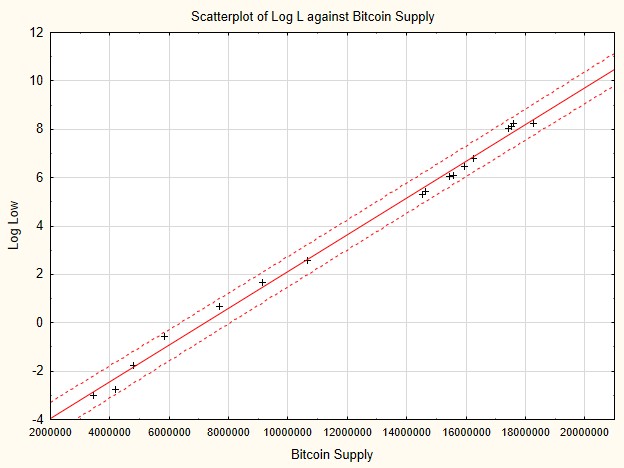
In doing so I discovered that there is a fairly strong linear relationship between the logarithm of the bitcoin price and the number of existing bitcoins at that particular moment.

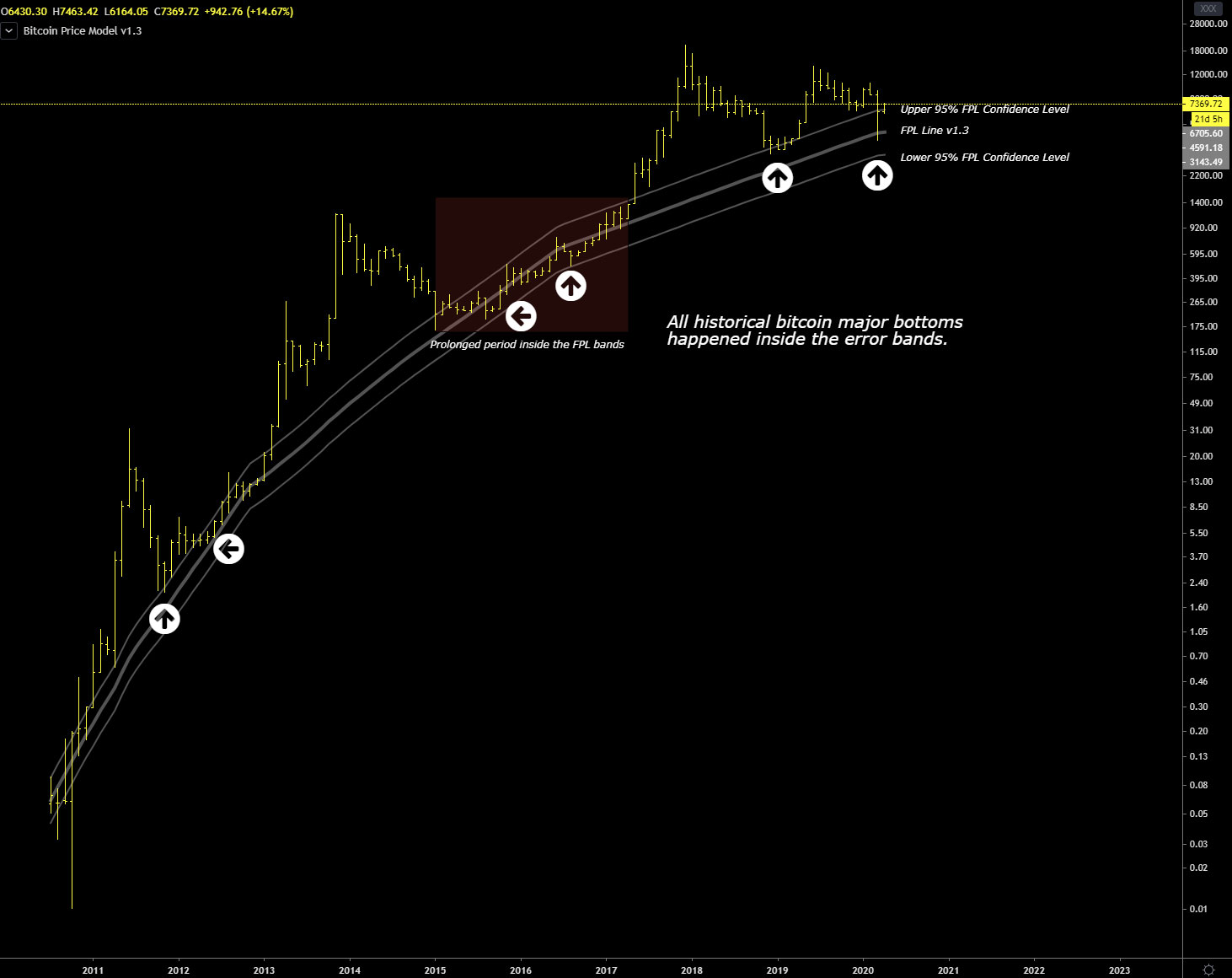
All the important bitcoin bottoms are inside the 95% confidence bands (dotted lines)

With the software i use isn’t complicated to find a formula that approximate all the selected bitcoin bottoms.
This is the dataset used to compute the model:

Date Low Bitcoin Supply
2010/07/17 $0.05 3436900
2010/10/08 $0.06 4205200
2010/12/07 $0.17 4812650
2011/04/04 $0.56 5835300
2011/11/23 $1.99 7686200
2012/06/02 $5.21 9135150
2013/01/08 $13.20 10643750
2015/08/26 $198.19 14536950
2015/09/22 $224.08 14637300
2016/04/17 $414.61 15439525
2016/05/25 $444.63 15582350
2016/10/23 $650.32 15943563
2017/03/25 $889.08 16235100
2019/02/08 $3,350.49 17525700
2018/12/15 $3,124.00 17423175
2019/03/25 $3,855.21 17608213
2020/03/13 $3,850.00 18270000

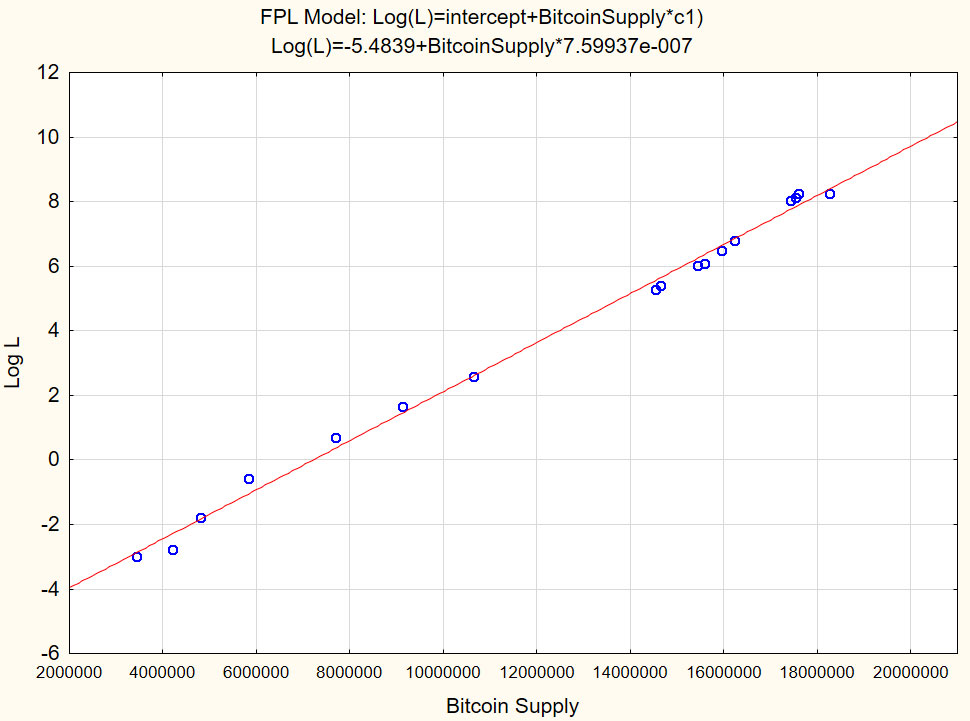
The Formula is a very simple one, a first order price regression  between log(Low) and Bitcoin supply:

Where:
FPL = expected line where bitcoin is fairly priced
intercept = a costant
c1 = another coefficient that defines the slope of the Bitcoin supply input.

Here’s the resulting model after computing the parameters of the above formula.

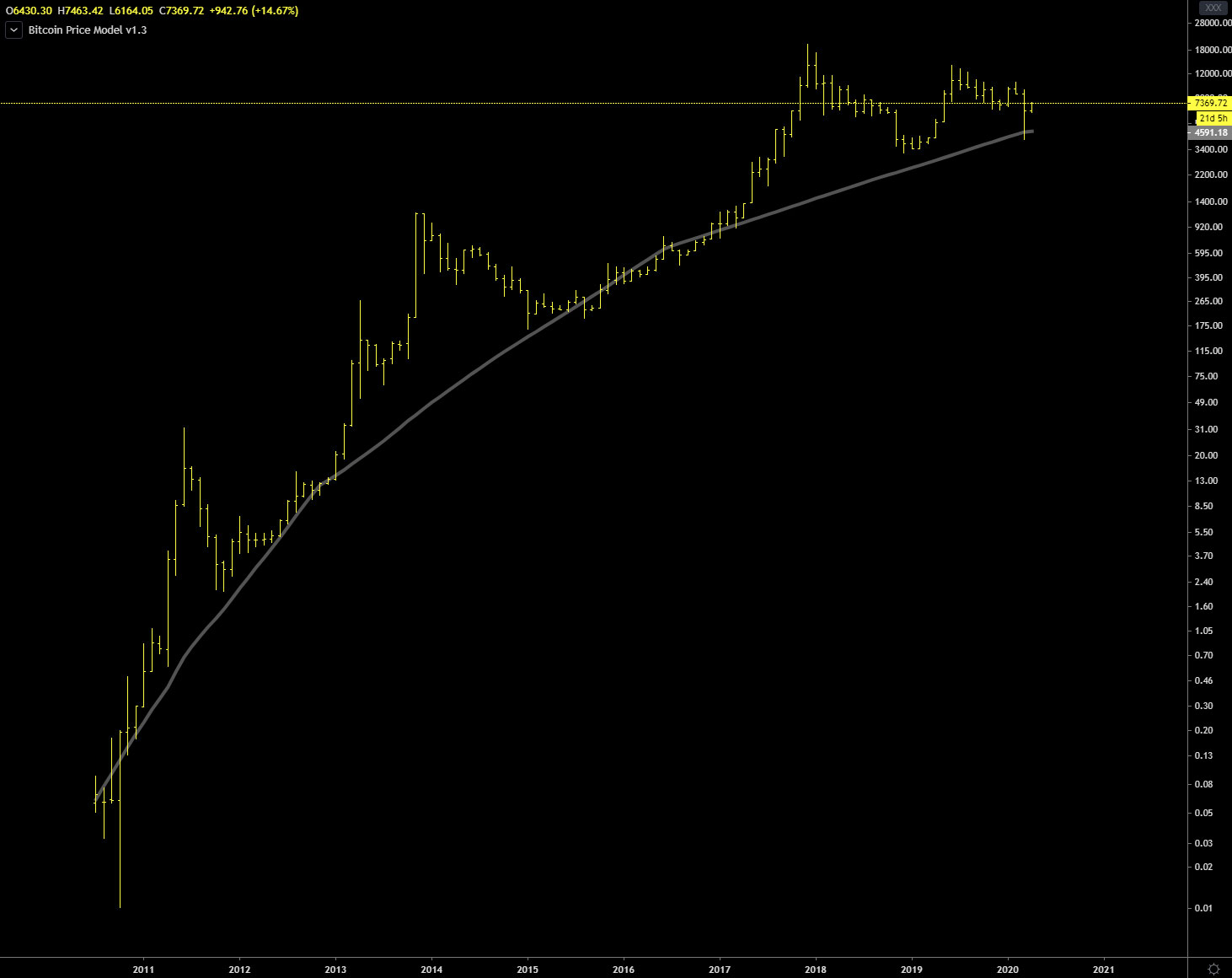
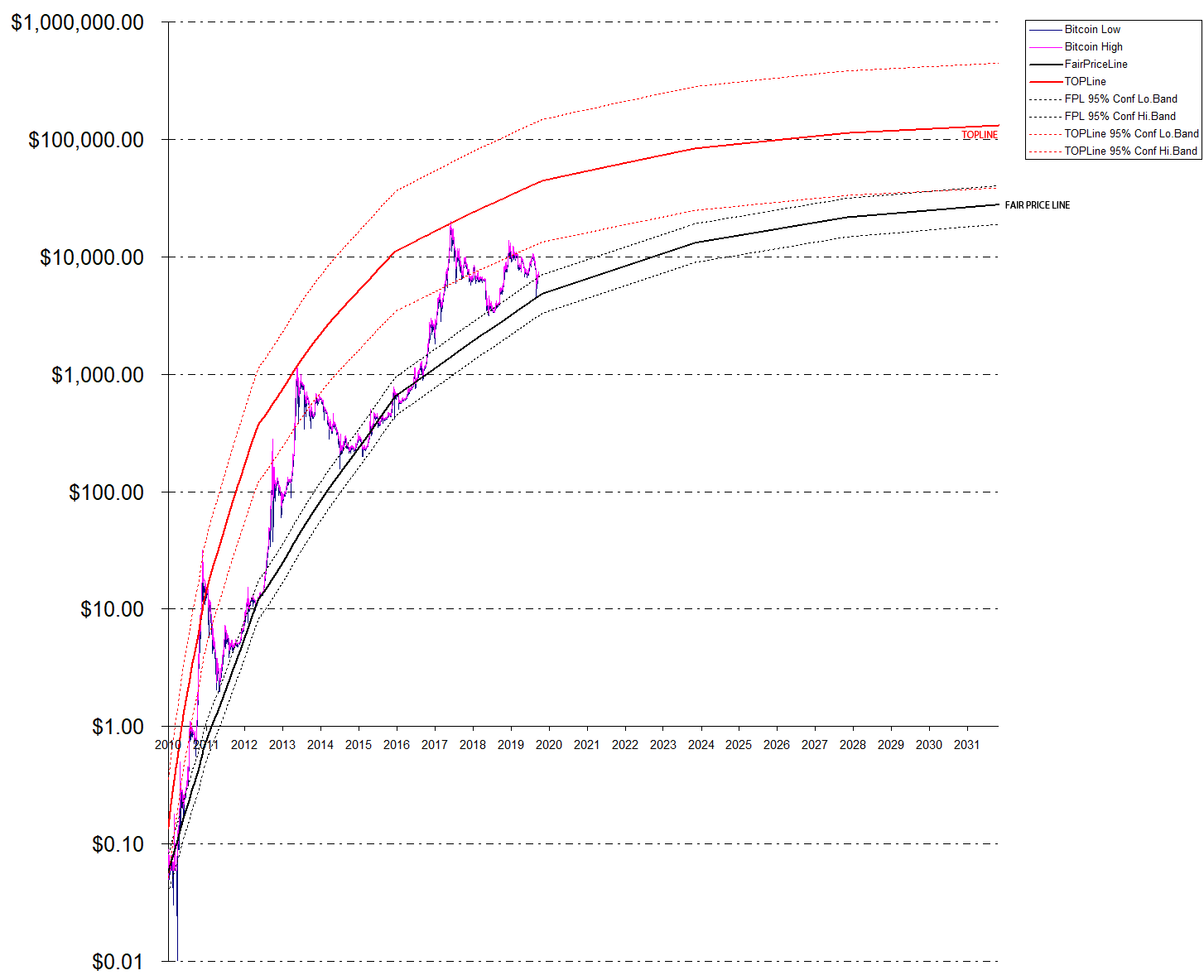
This is the new bitcoin price model “FPL Line” v1.3 applied to a monthly bitcoin/usd chart:

Next Step: Computing the formula for the TopLine

The formula for computing the Top is:


Where:
TopLine= is the forecasted price where the next long term top might be.
intercept = a costant
c1 = another coefficient that defines at which pow the bitcoin supply is elevated

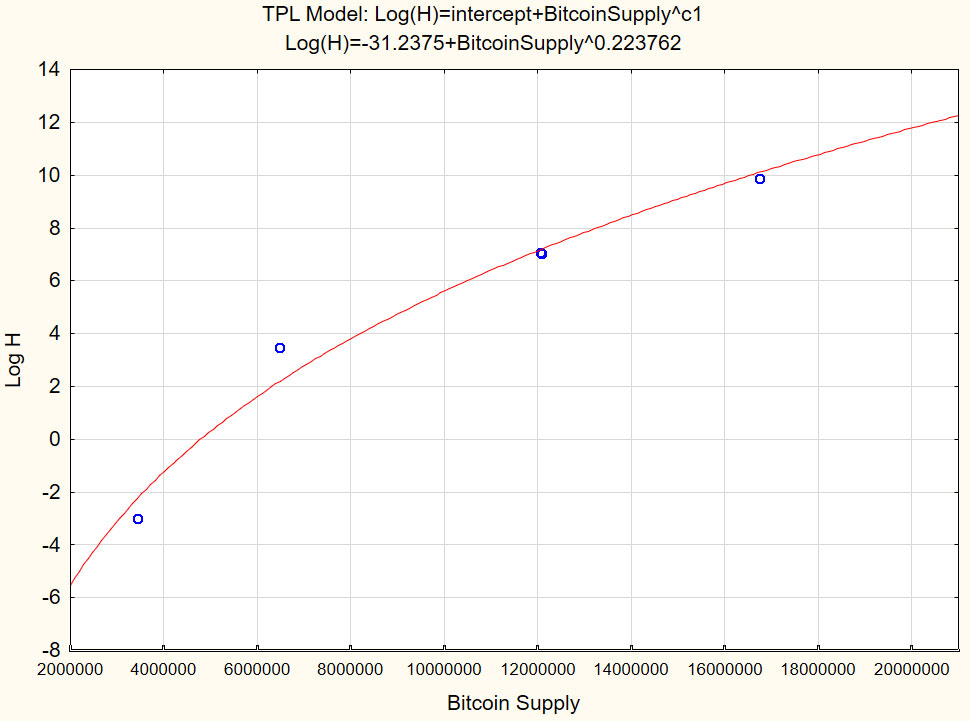
This formula is different from the one used to compute the FPL or bottom line. I’ve seen that there is not a strong linear relationship betweel the logarithm of important Bitcoin Tops and the Bitcoin supply, so i decided to switch to the formula used for the old model and it works better.

This is the dataset used to compute the model:

Date Price Bitcoin Supply
2010/07/17  $      0.05 3436900
2011/06/08  $      31.91 6471200
2013/11/30  $      1,163.00 12058375
2013/12/04  $      1,153.27 12076500
2017/12/19  $    19,245.59 16750613

Here’s the resulting model after computing the parameters of the above formula.

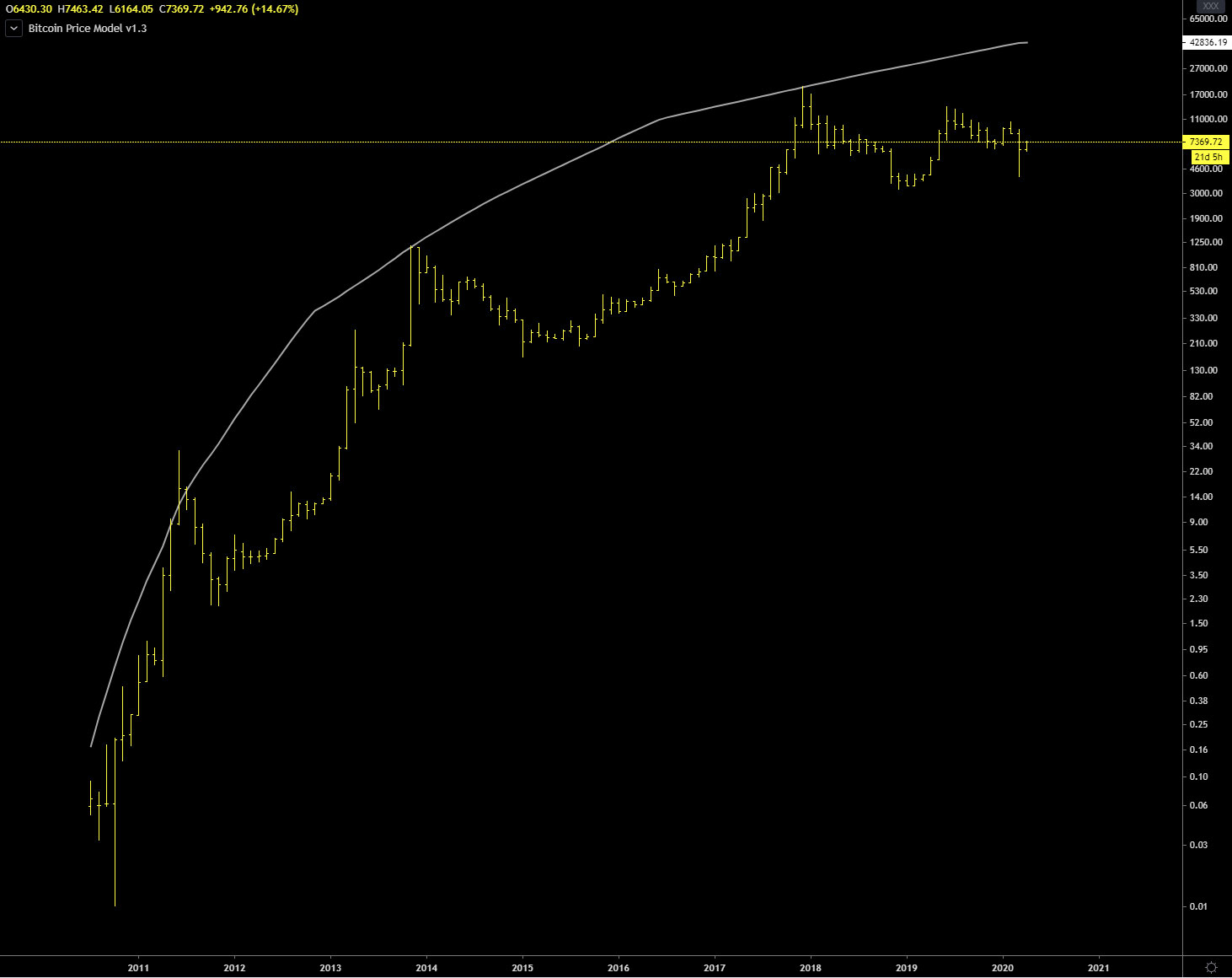
This is the new bitcoin price model “Top Line” v1.3 applied to a monthly bitcoin/usd chart:

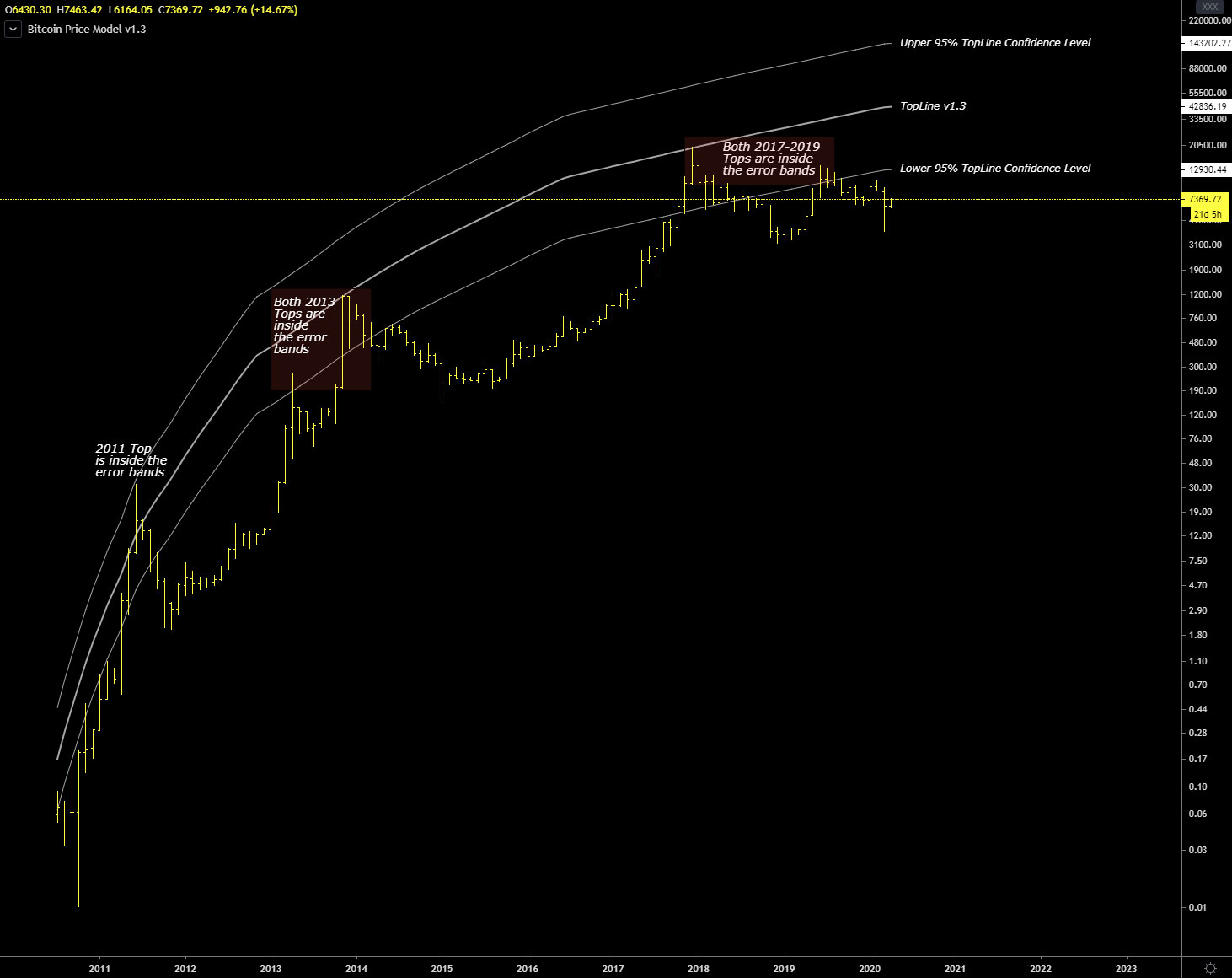
95% Confidence Error Bands

With the indicator that i give you for TradingView i included also the error bands.
This are the error bands for the TopLine:

And for the bottom line or FPL (FairPriceLine)

It is quite obvious that with fewer points available the error bands for the TopLine are wider and less accurate compared to the FPL error bands where I have more points (17 instead of 5).

TradingView Indicator

I have also included an indicator for TradingView to give you the opportunity to experience the concepts and model illustrated in this update. You can also check the code and/or modify it as you like.

On April 10th, 2020 tradingview staff decided to censor my indicator and threatened to close my account, because of this i publish here the code so you can create your own indicator by yourself.

Bitcoin Model v1.3 Sourcecode:

Code is also available at pastebin

Remember to add a “TAB” key once before stock (line 10 and 13), in the process of copying and pasting data back and forth from tradingview the tab key is gone probably because there is not a tab code in HTML.

//@version=2

study(“Bitcoin Price Model v1.3”, overlay=true)

//stock = security(stock, period, close)
stock = security(“QUANDL:BCHAIN/TOTBC”,’M’, close)

if(isweekly)
//insert “TAB” key before stock
stock = security(“QUANDL:BCHAIN/TOTBC”,’W’, close)
if(isdaily)
//insert “TAB” key before stock
stock = security(“QUANDL:BCHAIN/TOTBC”,’D’, close)

FairPriceLine = exp(-5.48389898381523+stock*0.000000759937156985051)

FairPriceLineLoConfLimit = exp(-5.86270418884089+stock*0.000000759937156985051)
FairPriceLineUpConfLimit = exp(-5.10509377878956+stock*0.000000759937156985051)

FairPriceLineLoConfLimit1 = exp(-5.66669176679684+stock*0.000000759937156985051)
FairPriceLineUpConfLimit1 = exp(-5.30110620083361+stock*0.000000759937156985051)

plot(FairPriceLine, color=gray, title=”FairPriceLine”, linewidth=4)

show_FPLErrorBands = input(true, type=bool, title = “Show Fair Price Line Error Bands 95% Confidence 2St.Dev.”)
plot(show_FPLErrorBands ? FairPriceLineLoConfLimit : na, color=gray, title=”FairPriceLine Lower Limit”, linewidth=2)
plot(show_FPLErrorBands ? FairPriceLineUpConfLimit : na, color=gray, title=”FairPriceLine Upper Limit”, linewidth=2)

show_FPLErrorBands1 = input(false, type=bool, title = “Show Fair Price Line Error Bands 68% Confidence 1St.Dev.”)
plot(show_FPLErrorBands1 ? FairPriceLineLoConfLimit1 : na, color=gray, title=”FairPriceLine Lower Limit”, linewidth=1)
plot(show_FPLErrorBands1 ? FairPriceLineUpConfLimit1 : na, color=gray, title=”FairPriceLine Upper Limit”, linewidth=1)

TopPriceLine = exp(-30.1874869318185+pow(stock,0.221847047326554))
TopPriceLineLoConfLimit = exp(-30.780909776998+pow(stock,0.220955789986605))
TopPriceLineUpConfLimit = exp(-29.5940640866389+pow(stock,0.222738304666504))

TopPriceLineLoConfLimit1 = exp(-30.3683801339907+pow(stock,0.221575365176983))
TopPriceLineUpConfLimit1 = exp(-30.0065937296462+pow(stock,0.222118729476125))

plot(TopPriceLine, color=white, title=”TopPriceLine”, linewidth=2)

show_TOPErrorBands = input(false, type=bool, title = “Show Top Price Line Error Bands 95% Confidence 1St.Dev.”)
plot(show_TOPErrorBands ? TopPriceLineLoConfLimit : na, color=white, title=”TopPriceLine Lower Limit”, linewidth=1)
plot(show_TOPErrorBands ? TopPriceLineUpConfLimit : na, color=white, title=”TopPriceLine Upper Limit”, linewidth=1)

show_TOPErrorBands1 = input(false, type=bool, title = “Show Top Price Line Error Bands 68% Confidence 1St.Dev.”)
plot(show_TOPErrorBands1 ? TopPriceLineLoConfLimit1 : na, color=white, title=”TopPriceLine Lower Limit”, linewidth=1)
plot(show_TOPErrorBands1 ? TopPriceLineUpConfLimit1 : na, color=white, title=”TopPriceLine Upper Limit”, linewidth=1)

Forecast up to 2032

Bitcoin Model 1.3

This is a forecast up to 2032 halving, price will saturate between 27,000$ and 130,000$ with a maximum possible peak at 450,000$ in case of a strong bubble.

Conclusions

This model is clearly experimental, we will see in the future how it will behave. It is probably questionable my choice to use the existing bitcoin supply instead of using time as a main input for the model, I’m curious to know your opinion about it. Thank you.

Quantitative Update: Bitcoin vs. The Rest of the World

This post is meant to be an addition to what I said earlier this year. Here we compare, in the same historical period of existence of bitcoin, Bitcoin vs other assets: us stock market indexes, US stocks of different sectors and Gold.

Let’s start with this summary table, who follow me regularly should already know the meaning of Shannon’s probability, RMS, G yield and compounded annual G yield; for all the others I refer you to the end of the article.
The data have been sorted in descending order according to Compounded Yearly Gain  G.

Comparison Bitcoin vs. The rest of the world
July 17, 2010 – Dec 31, 2019

Asset RMS or Volatility Shannon Probability P Daily Gain G Compounded Yearly Gain  G Optimal Fraction of your capital to wage
Bitcoin               0.0567                       0.5219        1.00087 38% 4.4%
MasterCard               0.0155                       0.5265          1.0007 19% 5.3%
Visa               0.0144                       0.5241          1.0006 16% 4.8%
Amazon               0.0193                       0.5196        1.00057 15% 3.9%
Apple               0.0161                       0.5172        1.00042 11% 3.4%
Google               0.0148                       0.5167        1.00038 10% 3.3%
Microsoft               0.0143                       0.5169        1.00038 10% 3.4%
Nasdaq Composite Index               0.0106                       0.5179        1.00032 8% 3.6%
Standard & Poor’s 500 Index               0.0091                       0.5160        1.00025 6% 3.2%
McDonald               0.0098                       0.5119        1.00019 5% 2.4%
Berkshire Hathaway Inc. (W.Buffett)               0.0105                       0.5112        1.00018 5% 2.2%
Pfizer               0.0115                       0.5078        1.00011 3% 1.6%
Facebook               0.0226                       0.5080        1.00010 3% 1.6%
Tesla               0.0318                       0.5096        1.00010 3% 1.9%
JPMorgan               0.0155                       0.5070        1.00010 2% 1.4%
Intel               0.0153                       0.5040        1.00001 0% 0.8%
**Gold (XAUUSD)               0.0094                       0.4951        0.99986 -3% 0%
*Ethereum               0.0634                       0.5138        0.99974 -6% 0%
General Motors               0.0178                       0.4903        0.99950 -12% 0%
General Electric               0.0164                       0.4868        0.99943 -13% 0%

*Ethereum Data since Aug 7, 2015, source coinmarketcap.
**Gold since 1970 has been a bit better with +3% yearly compounded gain.

The first comparison to make is with the main competitors of bitcoin, credit cards. I’m surprised to see how good are quantitative parameters of Mastercard and Visa, on the other hand they are monopolies, perhaps that’s why the CEO of mastercard hates so much Bitcoin, he sees it as a strong threat. Even Amazon has worse parameters compared to Visa and MC.

I included only Ethereum  in the comparison because in terms of market cap is second to Bitcoin, its yearly yield G is negative and i’m not surprised because I remind you that volatility reduces by far the yield G and in the case of all altcoins, not only Ethereum, the volatility reaches very high levels and therefore as an investment vehicle altcoins in general are absolutely not recommended, can eventually be considered as purely speculative assets for short-term trading.

Unfortunately for Mr.P.Schiff, in the last ten years Gold performed badly, for your curiosity i computed Gold parameters using available daily data since January 1970 and its yearly gain G or yield has been +3%, nothing exceptional, basically Gold protected you against inflation in the last fifty years but nothing more then this.

As i said 20 days ago Bitcoin volatility is dropping but it remains very high compared to other assets, despite this Bitcoin yearly compounded gain G is an astonishing +38% and it’s the best investment vehicle of the world.
Compared to other bitcoin price models this value is not much, ten years from now compounding 38% yearly bitcoin should be at around 200k usd while, for example, the stock to flow model has a forecast of 10 millions usd after 2028 halving, this is the equivalent of 144% yearly compounded gain instead of 38%.
Let me know what you think, does the stock to flow model price return appear realistic to you or not? Personally i prefer to rely on numbers and they say a clear “no” to me. This is why i’m a bit skeptic about also the bitcoin price model i developed on tradingview but i’m curious to see how it’ll end in a couple of years.

Tech Addendum

The concept of entropic analysis of equity prices is old and it was first proposed by Louis Bachelier in his “theory of speculation”, this thesis anticipated many of the mathematical discoveries made later by Wiener and Markov underlying the importance of these ideas in today’s financial markets. Then in the mid 1940’s we have had the information theory developed by Claude Shannon , theory that is applicable to the analysis and optimization of speculative endeavors and it is exactly what i’ve done just applied to bitcoin and the other assets considered in the above table, especially using the Shannon Probability or entropy that in terms of information theory, entropy is considered to be a measure of the uncertainty in a message.
To put it intuitively, suppose p=0, at this probability, the event is certain never to occur, and so there is no uncertainty at all, leading to an entropy of 0; at the same time if p=1 the result is again certain, so the entropy is 0 here as well. When p=1/2 or 0.50 the uncertainty is at a maximum or basically there is no information and only noise.
Applying this entropy concept to an equity like a stock or a commodity or even bitcoin itself common values for P are 0.52 that can be interpreted as a slightly persistence or tendency to go up, this means that for example stock markets aren’t totally random and up to some extend they are exploitable, same for btc.
Knowing the entropy level of bitcoin/usd is crucial if we want to compute its main quantitative characteristics, as i explained in the technical background of my blog this process is quickly doable once you have all the formulas, the process is as follows:

To compute the Shannon Probability P you should follow these steps:

  1. compute natural logarithm of data increments (today price / yesterday price)
  2. compute the mean for all data increment computed in step 1
  3. compute RMS (root mean square) of all data increments, squaring each data increment and sum all togheter
  4. Compute price momentum probability with the formula P = (((avg / rms) – (1 / sqrt (n))) + 1) / 2
    where avg = data computed in step 2, rms = data computed in step 3, n = total samples of your dataset. If the resulting probability is above 0.5 then there is positive momentum, otherwise under 0.5 negative momentum

To compute the Gain Factor use the following formula:

G = ((1+RMS)^P*((1-RMS)^(1-P))

To compute the yearly gain G or growth just raise daily gain G to the 365th power for Bitcon or 252 for stocks (252 trading days in a year).

Long Term Update: Volume Analisys at Kraken/Bitstamp Part II

Old post is here

The trading platform used here is unchanged: Sierrachart 64 bit.
The big amount of tick data processed to compute this interesting volume oscillator wouldn’t be possible to do at TradingView or similar online platforms.
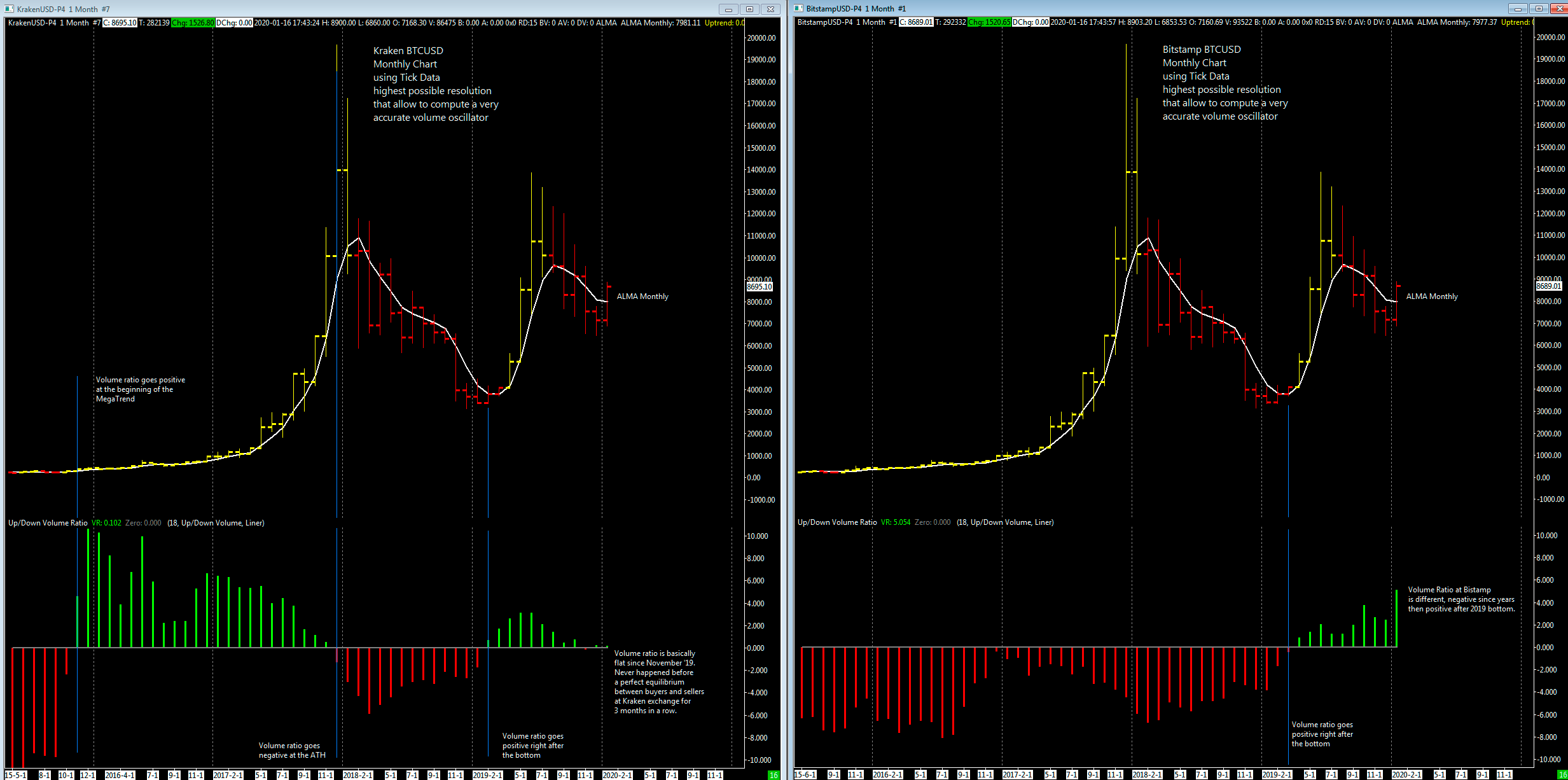
The “up/down Volume Ratio” oscillator is computed and smoothed using a 18 periods (18 months or 1 year and a half) linear regression moving average.
Volume made on an uptick is considered positive while if made on a downtick is negative, then the aforementioned oscillator is applied.
I added also in the chart the widely know ALMA moving average (9 periods, standard settings).

I added for comparison the same template applied to BTCUSD at Bitstamp exchange.

Volume Ratio Oscillator Kraken/Bitstamp Comparison (click to enlarge)

Very curious to see a perfectly balanced volume activity at Kraken exchange for 3 months in a row while at the Bitstamp the volume activity is unbalanced upwards.
As a positive note i can say that i don’t see any negative volume activity in either of the two exchanges considered. Said this my best guess is that the price retracement from about $13800 to $6400 was a normal correction of a bullish market and that the bear market ended on March ’19.


My Bitcoin Price Model

Network economics

By definition Network economics is business economics that benefit from the network effect (Metcalfe Law), also known as Netromix and basically is when the value of a good or service increases when others buy the same good or service. Examples are website such as EBay where the community comes together and shares thoughts to help the website become a better business organization.

Since 2010 bitcoin has been depicted as silly, a permanent bubble, denigrated by major economists, financial institutions etc…, everyone thinking that the true value of bitcoin is unknown and not knowable or zero as modern currencies have no intrinsic value because they lack scarcity or durability advantage like commodities.

The value of a currency is the use and acceptance of that currency and so they still have some value despite the fact that there are zero intrinsic value. Looking Bitcoin i can say that its value is determined by the great functions it has that are considered valuable from the user base.

MetCalfe’S Law

The problem of extrapolating future values of Bitcoin is difficult because the number of users does not grow forever, at some point you reach a saturation level as the internet, if you look historical data you can see that since 2013-2014 the internet reached maximum capacity in terms of  number of worlwide hosts.

Metcalfe’s formula is:
V=n(n-1)/2
and determines the value of a network for a given n. Without entering too much in details this law says that a 5% increase in number of users should correspond to a 10% increase in the overall value of the system.

This law has already been successfully used to model the value of Facebook stock because it is strongly linked to its users, the same for bitcoin although is unclear how to estimate bitcoin number of users. A good estimation might be the number of bitcoin active addresses but all the traders providing liquidity to the system don’t do much bitcoin transactions and so they are not included in the count.

Stock To Flow Model

Recently this model is gaining popularity, i consider this model a bit optimistic in forecasting future values of bitcoin, regardless of my opinion here is the original article of the creator of this model.

My Approach

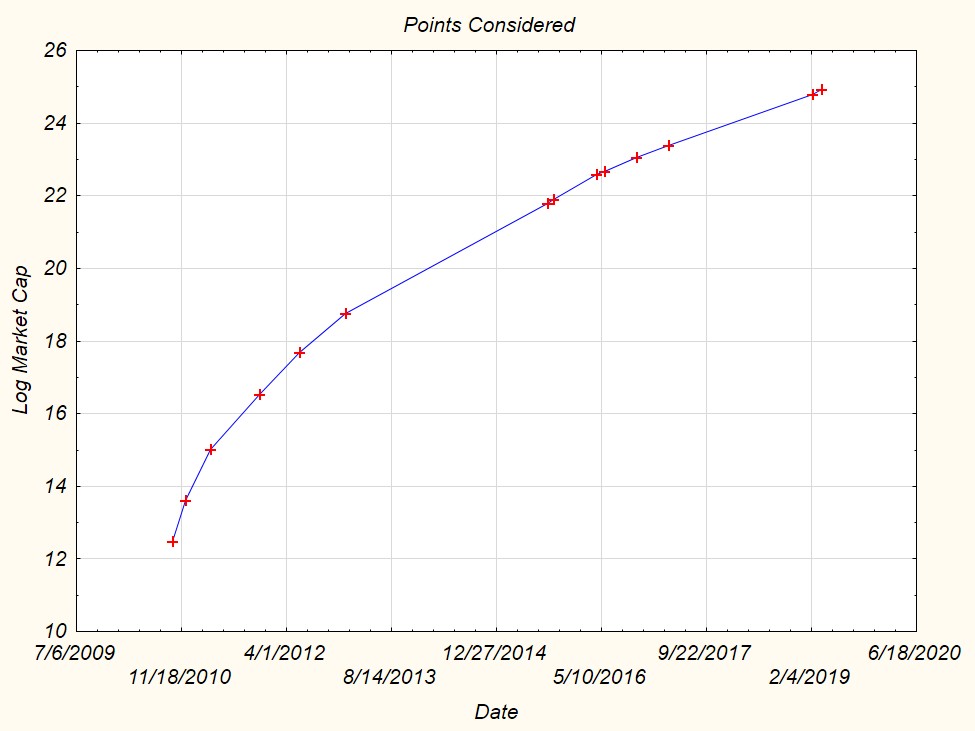
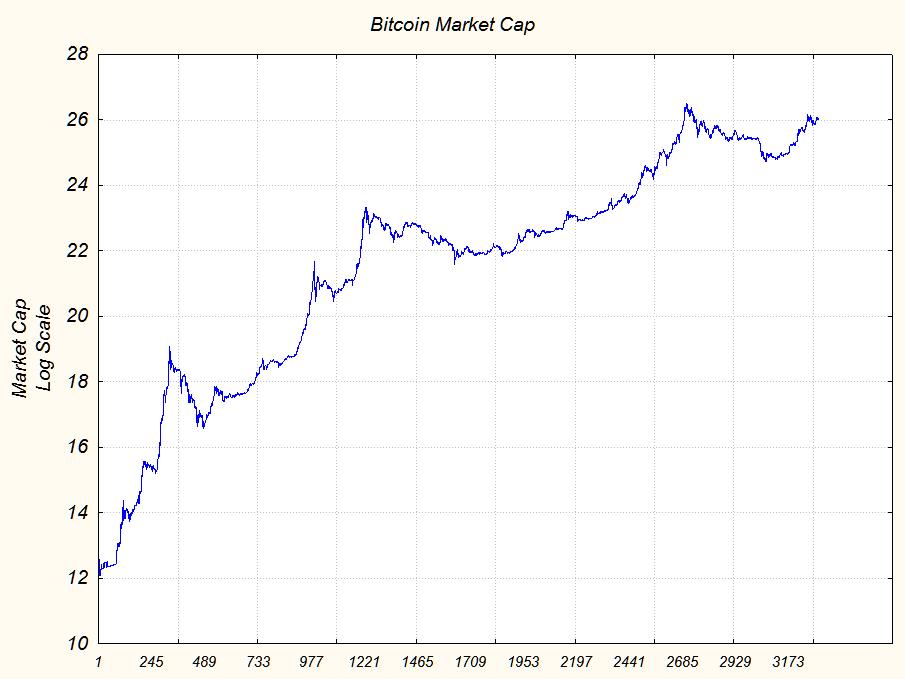
Bitcoin Market Cap (Log Scale)

My Idea is to don’t use the Metcalfe’s Law because i can’t estimate the number of worldwide bitcoin users fairly well, i prefer to model the size of the system just looking the Market Cap instead of Price, Why? Because in the first years the Bitcoin Supply greatly changed from few btcs to some millions and this is a big distorsion not included in the price chart.
Thanks to the software i already use for my conventional trading activity i perfectly know how to derive a formula to approximate the expansion of the bitcoin system using Market Cap as metric.
Looking the above chart it appears clear that there is a line holding bitcoin min values over time. Let’s find it!
I can’t use all the data values to find this line but i’ve to select ideal points, specifically thse are the points used:

Date Price
17-Jul-10  $        0.05
8-Oct-10  $        0.06
7-Dec-10  $        0.17
4-Apr-11  $        0.56
23-Nov-11  $        1.99
2-Jun-12  $        5.21
8-Jan-13  $      13.20
26-Aug-15  $     198.19
22-Sep-15  $     224.08
17-Apr-16  $     414.61
25-May-16  $     444.63
23-Oct-16  $     650.32
25-Mar-17  $     889.08
8-Feb-19  $  3,350.49
25-Mar-19  $  3,855.21

Bottom Points considered and converted to market cap.

The Formula i’m going to use is this:

Log(Mcap)=constant#1+time^constant#2+constant#3*exp(time/constant#4)

The lats part of the formula is to give more credit to recent values because i’m interested to perfectly fit last data over old data that has more noise.
The best result i’ve obtained to compute the different constants is:
Log(Market Cap)~=7.775+time^0.352+(0.1*exp(-time/0.1))

From this to obtain price you have to exponentiate everything and divide by the bitcoin supply for that particulare date, time is intended in number of days since July 17, 2010

Bitcoin Bottom Line

Now that i’ve a formula i can easily forecast it to see the corresponding Price for a particular date.
Next step is to do the same job to derive a formula for the Tops.
Points considered (only 4):

Date Price 
8-Jun-11  $      31.91
30-Nov-13  $  1,163.00
4-Dec-13  $  1,153.27
19-Dec-17  $19,245.59

Skipping now to the final result:
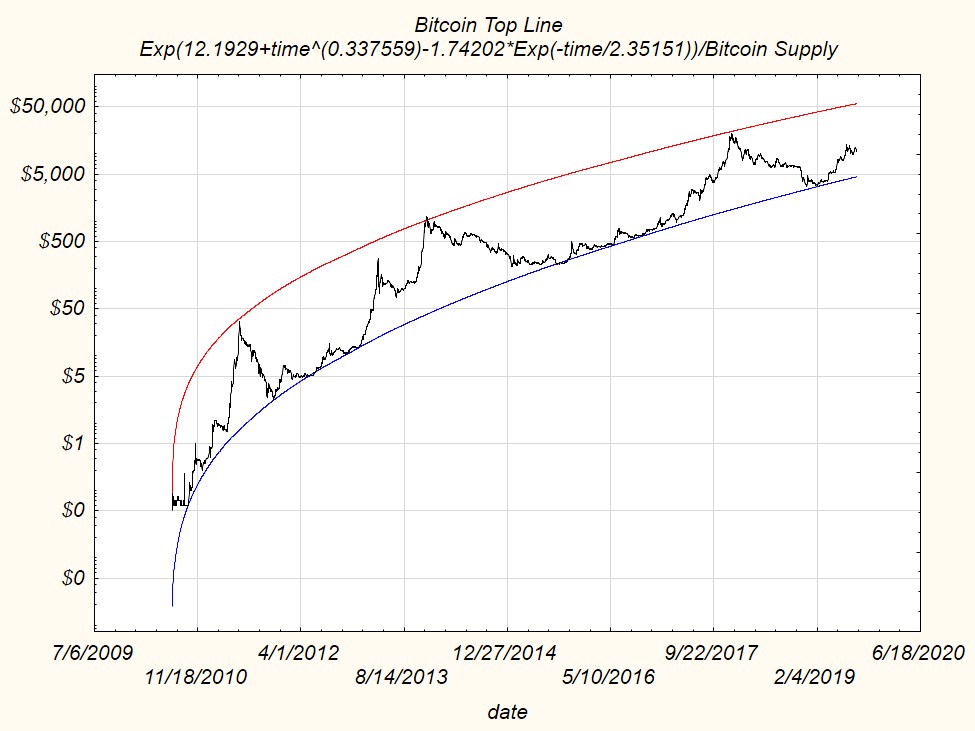
Bitcoin Top Line = Exp(12.1929+time^(0.337559)-1.74202*Exp(-time/2.35151))/Bitcoin Supply

Bitcoin Top Line

A careful observer has probably noticed that the coefficient for time is lower when calculating Tops instead of Bottoms (0.337 instead of 0.352) and there is an easy explanation for this: as long as bitcoin market cap grows in size there is more inertia and it is more difficult to manipulate the price far away from the bottom line, therefore I expect with the passage of time to have the next important Tops closer and closer to the reference line or bottom line or if you prefer the “Fair Price Line”, call it as you want.

4 Years in to the Future

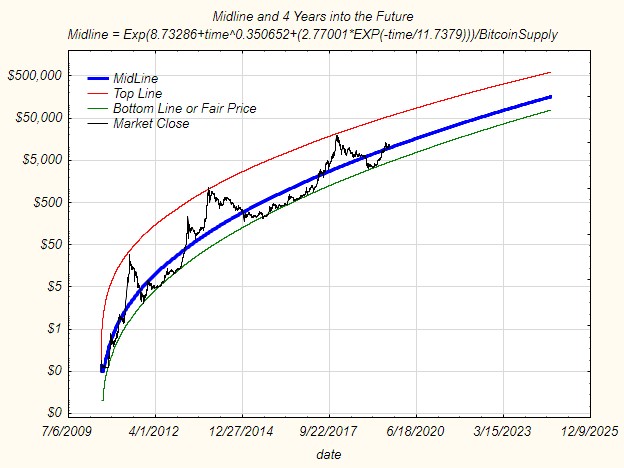
Once you have a model to define the boundaries where bitcoin price moves is easy to do a forecast and have a look where bitcoin might go in the next years. Here i propose a four years look in to the future.
Before let’see very quickly a third line very important: the MIDLINE. I computed it using all available data points since July 2010. Here the result plus the 4 years forecast:

Midline and 4 Years Forecast

I really like the result achieved with this model, apart the perfect fitting of all bottom and top points even the Mid Line is very important to understand where is the boundary between Fair Price and Overprice.
Furthermore bitcoin spends not much time above the Mid Line and very few days near the Top Line. Moreover the time spent below the Mid Line is equal to 62% and 38% of the time bitcoin price is above the Mid Line, I don’t know if Fibonacci is involved or not but the coincidence is odd.
Looking the above chart 4 years from now the forecasted price is impressive, i highly doubt the Top Line will work but i’d be already satisfied if Bitcoin will stay above the Bottom Line or Fair Price line, for your curiosity next September 2023 bottom line is at 47000$.

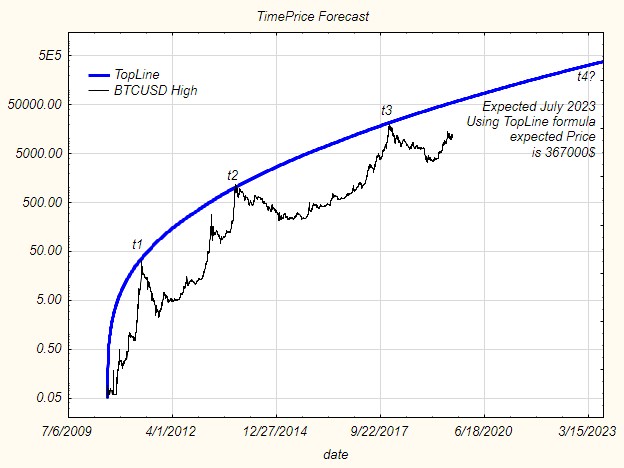
Timing the next All Time High, is it possible or not?

Well, looking the chart out careful observer probably noticed that there is a progression in time between all the Tops. Have a look:

Time Price Forecast

  1. First top happened after 327 days since July 17, 2010.
  2. Second top after around 1235 days.
  3. Third top after 2713 days.

Using the same approach used to derive previous formulas the formula for this numerical progression is:

TopDate=323.5*TopNumber^1.9354

Topnumber is the # of top considered, 4 for the next one and we obtain 4733 days since July 17, 2010 that is due on July 2, 2023. Knowing the time, just look for the price in the TopLine using my formula and the corresponding price is around 367000$.

I recognize that it is very ambitious to predict in advance of 4 years the next Top but I have extrapolated to the future what i observe today on the historical data.

I know that many of you are already asking “why is required so much time for the next top?” I think the answer is that due to the big growth of the bitcoin ecosystem this growth process is slowing down with the pass of time and therefore more and more time is needed for each new bubble to develop.

This will not mean that bitcoin price will stay all the time below my MidLine, some mini bubble might occurs in the next years and I’ll work on this subject to identify Intermediate Levels to accurately predict where these mini-bubble will end.
For example the recent June 26 Top at 13880$ happened outside the MidLine indicating that Bitcoin price was a bit overpriced. At that time the Midline was at 9050$ and Bitcoin at 13880$ was overpriced by 53%.
This month of September the Midline will move from 10150$ to 10650$ and bitcoin these days is rising to recover that line after a quick drop to 9320$.

Next Thing To Do

As i said i’m satisfied with the result obtained also in terms of R2 of my regression of Tops/Bottoms points, R2 is around 0.99 or basically a perfect FIT of the data points. Of course academically speaking my model doesn’t pass the infamous Durbin-Watson test because the residual of my model has some autocorrelation (as it has also the stock to flow model proposed by PlanB). By the way an academic invalidated model doesn’t mean it will not work but we must play by the rules.
Said this i’ve to found a way to model the distance between my Fair Price Line or Bottom Line and Bitcoin Price trying to have residual without autocorrelation and i’ll probably fail. Why? Because it is difficult to model price behaviour if there is fraudolent activity going on as it could have happened during 2013 with the famous bot “Willy” pumping prices at MtGox or recent manipulation by hedge funds that pushed the price from the fair value of 800$ (January 2017) up to 19800$.

Final Considerations and Gompertz

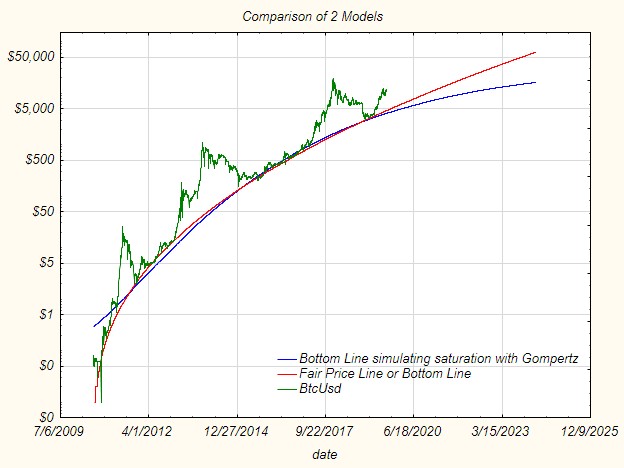
Benjamin Gompertz is the author of a sigmoid function which describes growth as being slowest at the start and end of a given time period and the future value asymptote of the function is approached more gradually by the curve than the left-hand or lower valued asymptote. I started this article talking about the importance of the user base as a way to simulate saturation because there is a limited number of users that limit the growth of a system, and now i conclude this article trying to model bitcoin price using the formula provided by Mr.Gompertz.
The formula is:

Price=Exp(27.3225*Exp(-0.682014*Exp(-0.00061457*time)))/BitcoinSupply

Time as usual is counted in days since July 17 , 2010.
In the below chart there is a comparison between the above formula and the formula for the Bottom Line or Fair Price Line.

My First Model and Gompertz

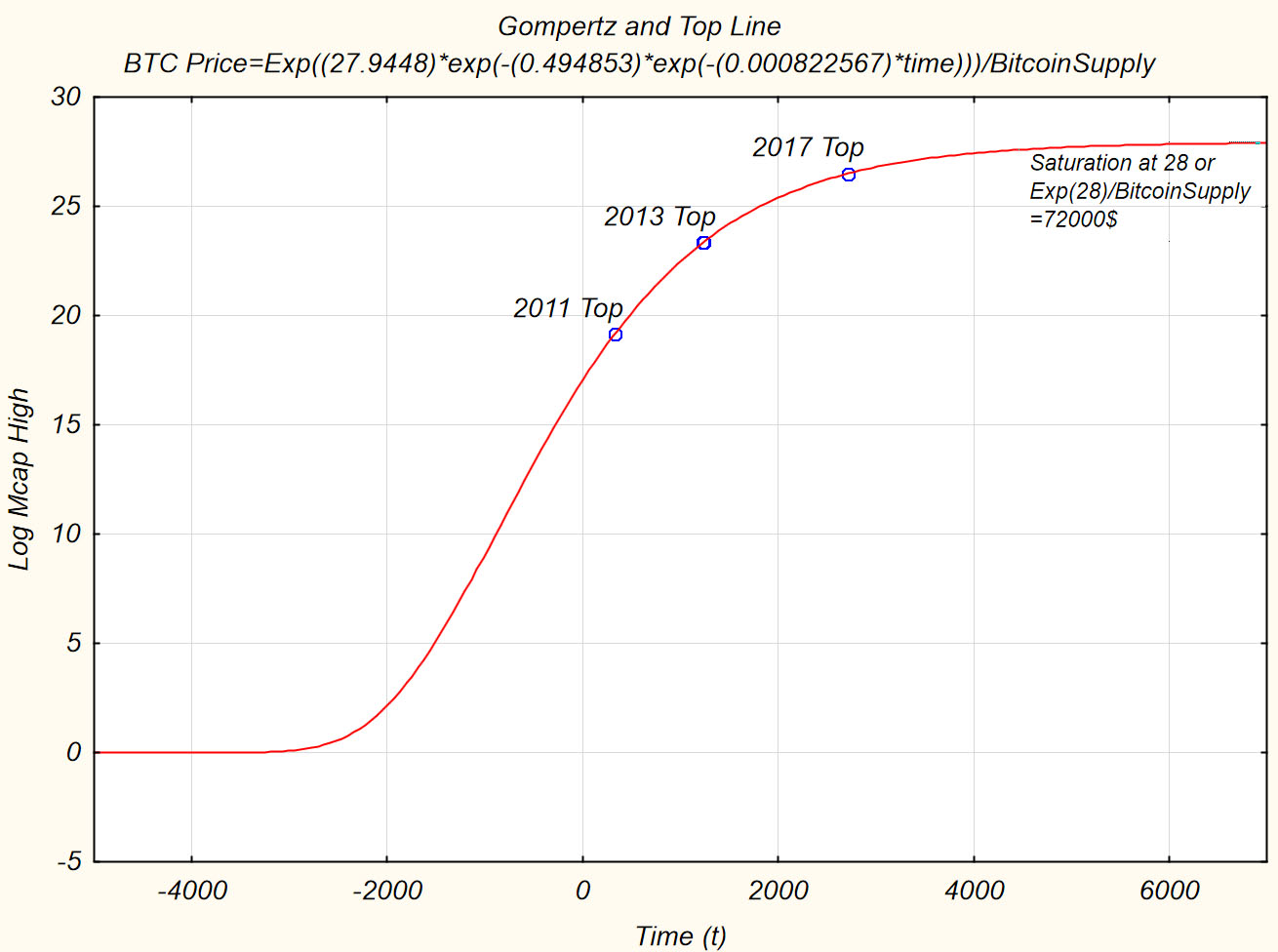
As you can see simulating saturation lower the Fair Price of Btc in a significative way. The saturation point is around 26000$, instead working with tops the saturation point is 72000$, here is the chart:

TopLine saturated using Gompertz Formula

There is a big consideration to do about this attempt to simulate the saturation of the bitcoin system, the quality of the user base.
I can’t know if in the upcoming years the user base wealth distribution will remain the same or not, if there will be a new influx of user with more money because attracted by the “digital gold” aspect of bitcoin this will surely push bitcoin prices above the forecasted range of 26-72 k$ of this model.

Another consideration looking the last chart is that the starting point is well in the past, 4000 days before July 2010 or December 1999, it is a date close where everything started, the publication of “BitGold” by Nick Szabo, a direct precursor to the Bitcoin architecture.

For now i stay stick with my first model that doesn’t include saturation but i’ll keep an eye on my second model.

Thank you for your attention and I hope to have been quite clear and detailed, as always if you have any questions do not hesitate to leave a comment or write to me on Twitter.

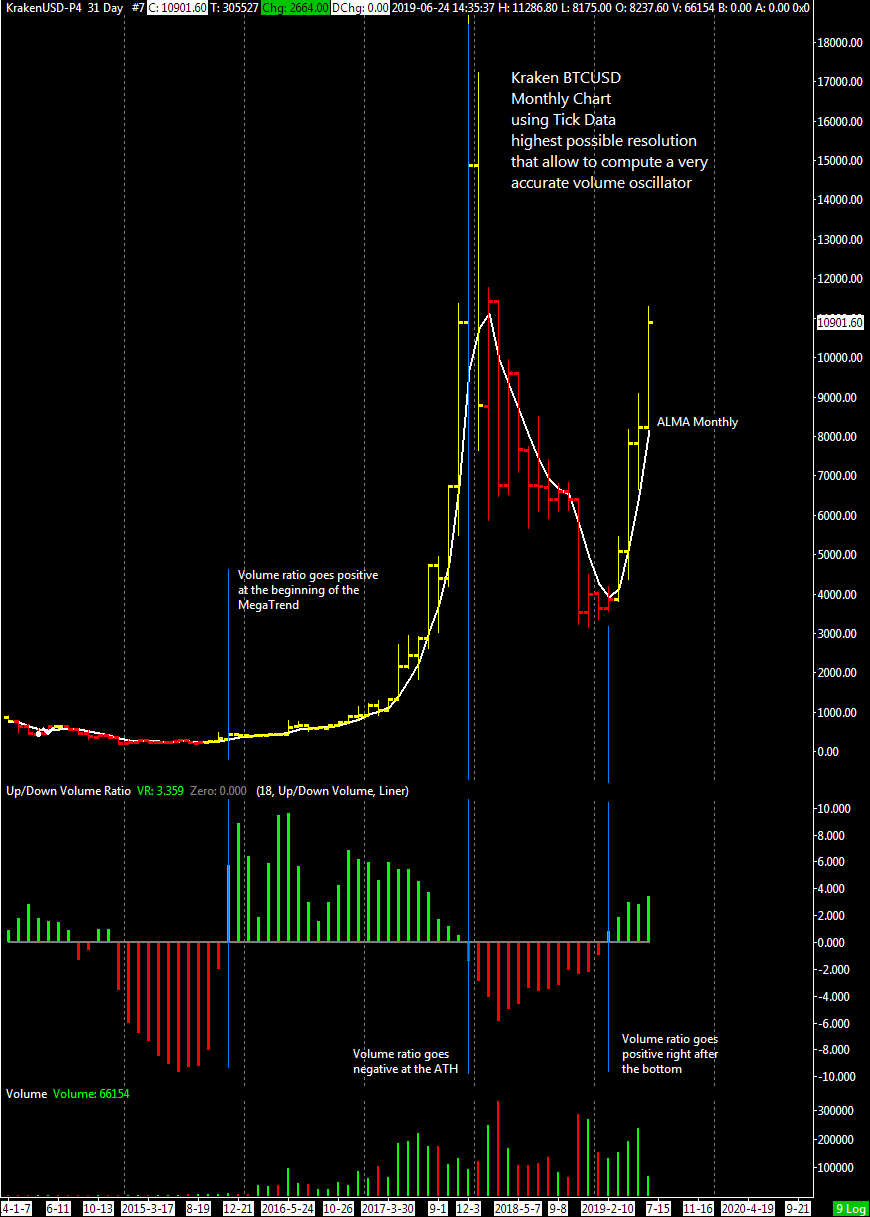
Long Term Update: Volume Analisys at Kraken

For those who follow me on Twitter already knows that I opened a long term position after many months out of the market, to support this decision today i like to share with you this analysis made on volumes thanks to the data of the Kraken exchange using the BTCUSD cross. With other exchanges the analysis is however interesting but less accurate, I got the best results with Kraken.
The analysis starts from an accurate measurement of volume activity using tick data, each trade is considered in the calculation to have a net result about the flow of volume.

KrakenUSD-P4 31 Day #7 2019-06-24 14_58_33.739

For who follow me on this blog should know that the trading platform used here is Sierrachart 64 bit, the big amount of tick data processed to compute this interesting volume oscillator wouldn’t be possible to do at TradingView or similar online platforms.
The “up/down Volume Ratio” oscillator is computed and smoothed using a 18 periods linear regression moving average. I added also in the chart the widely know ALMA moving average (9 periods, standard settings).

I think i’ll probably use this template to help me to understand when the current uptrend will end and at the same time to maximize the trade exit efficiency of my current long term trade.

I conclude this short post spending two words about what i said in my previous blog update (Jan 2019). Well, this market broke the first resistance at 9k usd (it was a conservative target already met) and the next one is around 16k usd. At that time i wrote also that increasing the volatility factor from 1x to 1.5x the next important resistance is near 30k usd. I really think that if a big trend develops this year, it will probably end near this resistance level.

The current reason beyond this uptrend might be that the market is discounting the next year block halving that in the past always pushed the price very high; i’ve seen a model out there on the web forecasting bitcoin at 55k usd because of this incoming halving, basically an attempt to model bitcoin price starting from its scarcity.

Don’t forget to follow me at Twitter, it’s quicker to post update there for me.


Long Term Update

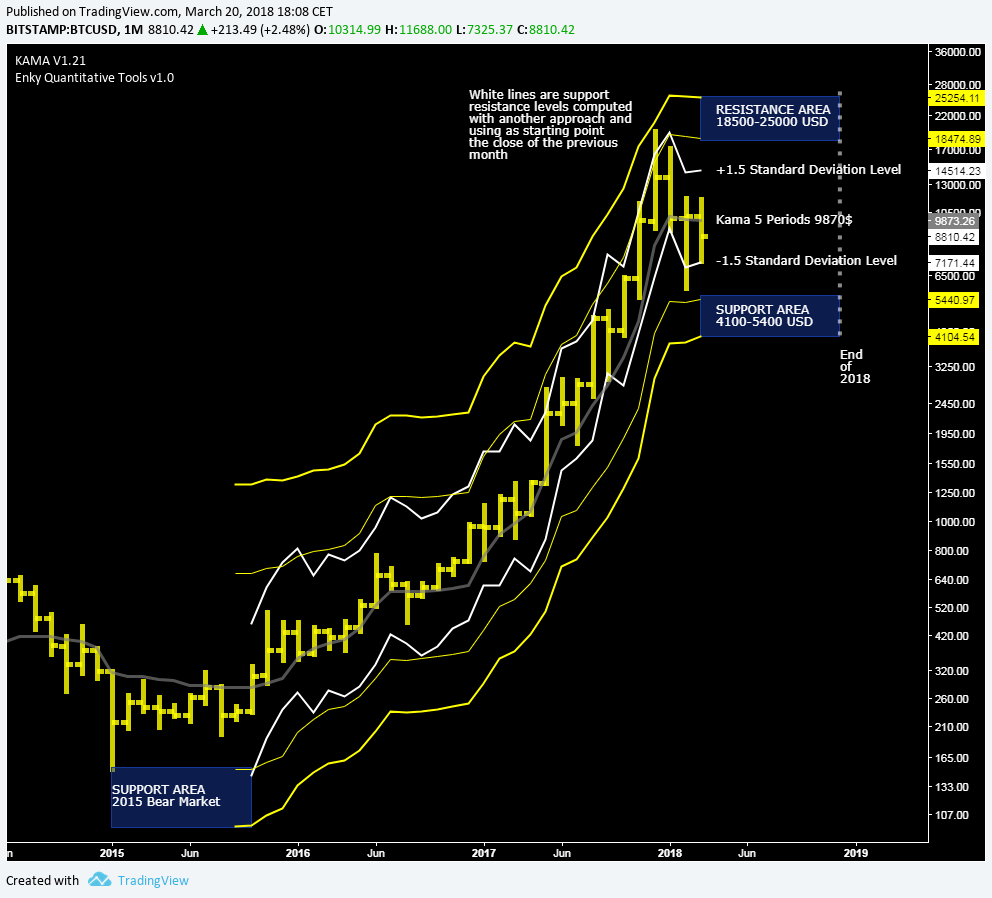
BTCUSD Monthly Chart KAMA Average 5 periods and deviation lines.

Since the last update on February 13 there are not many new developments. The monthly KAMA average is flat, which allows us to calculate fairly reliable levels of support and resistance. As you can see nothing interesting happened with the BTCUSD cross that remains inside the supports and resistance levels (yellow lines).

I have added a new indicator that calculates supports and resistances using as a starting point the close of the previous month (with the idea to forecast next month support/resistance levels), in this case the close of February at about $ 10300. I have used the last 50 months, just over 4 years from the bear market’s lowest point in 2015, to calculate volatility.

The drop we have seen in recent days has reached an intermediate level, -1.5 standard deviations, so I can say that there has not been a level of extreme volatility but not even normal.

My opinion is that the bitcoin will continue to remain for most of the year within the levels calculated with the KAMA (yellow) and therefore remains a good opportunity to buy the price area from 4000 to 5500 dollars, while it is to be evaluated a reduction of any bullish position should the BTCUSD go above 25 thousand dollars.

I also give you some short term indications for the next days, the first resistance is $9500, you might see a Top not exceeding $9500 before the BTCUSD resumes its descent. A break above $10000 would mean that at least in the short term the bearish trend is over.


ITA Version here

Long Term Update: Bottom Done Yes or No?

On 18 January 2018, I wrote that the bottom was probably done but I hinted that at the break of the same I would have closed my long term position, unfortunately there was a subsequent very strong selling activity after a weak reaction from the support of the weekly chart (at about 9500$). In these cases it is useful to scale the time frame to the next one (from weekly to monthly), so i applied the KAMA average and its deviation lines to the monthly graph instead of applying them to the weekly graph.
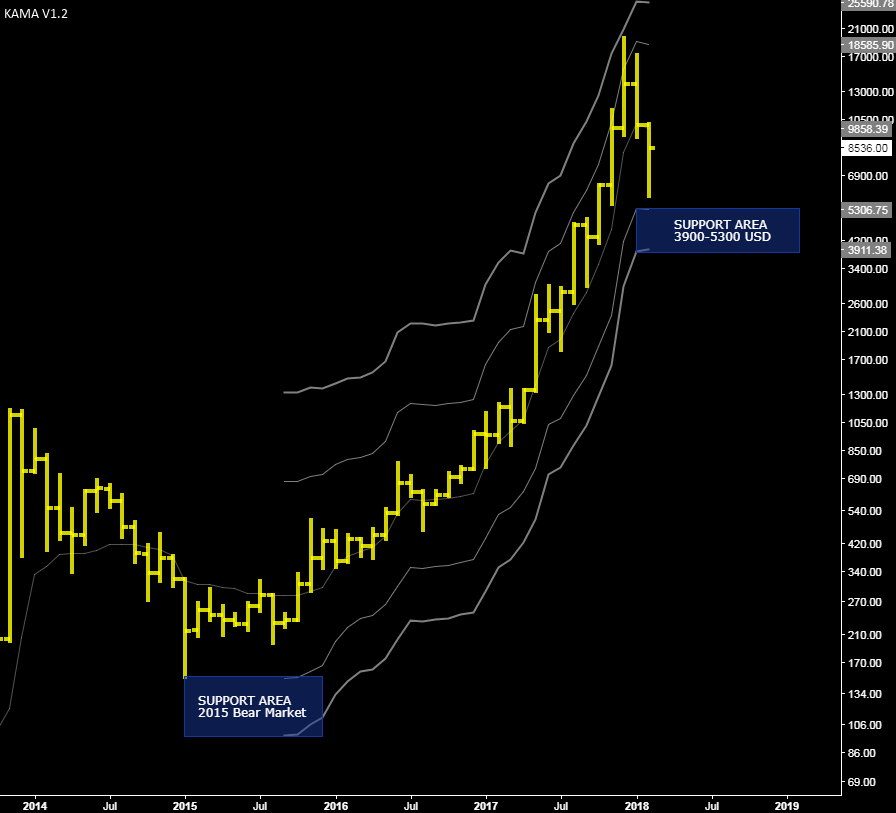
The resulting graph is this at the moment and the market has reacted strongly from this support area.

monthly chart btcusd
BTCUSD Monthly Chart – Kama and deviation lines

You can see that the first deviation  line has hold the price from further lows at the end of the 2014-2015 bearish market, the same negative deviation line reported to date is at about $ 5300 and the market, for now, has done a bottom at $ 5900. I’ts difficult for me to say if the bearish market started in December 2017 is over, I remain convinced that we will hardly see stable prices under $3900 and that the support area from $3900 to $5300 will be very strong for this year.

If during ther year the trend of the Kama average becomes bearish from flat we will have a confirmation that a down trend, even on the monthly chart, has been established and this would undermine a little the validity of the support area indicated in the chart.
For now I think that the market is still stronger than the 2014-2015 period and that any medium-term correction should be above the indicated support area.

Italian version here.


Long Term Update: 2018 Outlook with entropic methods

Every beginning of a new year i post an outlook using entropic methods explained in the technical section of this blog. Here you can find the 2015, 2016 and 2017 forecast update, where you can find more information about this approach.

Updated values for bitcoin (in brackets values of last year) using daily data since August 2010 (average of 4 exchanges when possible).

 BTC/USD
Growth Factor G 1.0028 (1.0007)
Shannon Probability P 0.5384 (0.519)
Root mean square RMS (see this as volatility) 0.059 (0.045 )

Bitcoin’s entropic values versus the Usd strongly improved in 2017 but volatility increased a bit, despite this the Growth Factor (G) increased up to 1.0028% (remember that volatility is detrimental to the Growth Factor) compounded daily or 280% yearly up from 30% of 1y ago. Also the optimal fraction of your capital to invest in bitcoin improved in 2017 with a 7.7% instead of 6.4% of 1y ago.

 2018 Price forecast  Full volatility  Half volatility
Forecast using only G* ~38700$ ~38700$
Upper bound adding volatility ~121000$ ~68000$
Lower bound subtracting volatility ~12300$ ~21800$

*38700 is obtained with today price (around 13800$) times (1.0028^365)=~2.77
13800*2.77=38740, just change 365 with the number of days you prefer for a different forecast.

It’s interesting to notice that with reduced volatility the support level is above the actual quote of XBTUSD (13800$ at the moment i’m writing) because the growth factor (G) is very high and is skewing everything to the upside. If volatility stays low the uptrend should push bitcoin above 22k USD during the year without too much effort, it’s a scenario i prefer instead of wild price swings.

What went wrong in 2017?

A year ago, I forecasted a top of $2900, reached in July 2017 with an intermediate Top well ahead of the end of the year. I tried to double the volatility factor (rms) to see the next level after a reader asked me about the possibility that bitcoin was in a bubble above 2900$. The next level was around 6000$, again this new level has been broken at the end of October.
The last 2 months have been crazy and the explanation is a huge change in shift in this market happened in March 2017 (with altcoins literally exploding) that basically erased the reliability of the January 2017 forecast. I think that this year forecast should be more accurate compared to last year.

Conclusions

For this year i think that i’ll consider the support/resistance levels obtained with a full volatility value with the result to have for the whole 2018 a good probability to stay inside the 12300$-121000$ price zone.
At the same time i think that at the end of a strong buying climax period, if any, it will be wise to reduce your bitcoin investment if the price goes above 60k-70k USD.

I’m at your disposal for any questions; see you at the next update and Happy New Year!

Quantitative Analysis of Altcoins, part III

In part I and II I did a quantitative analysis on altcoins and possible strategies on how to capitalize on their weakness compared to bitcoin.

In Part III we will see how to allocate a portfolio starting with Fiat currencies.

In the table below you will find cryptos with relative gains (G) and volatility (RMS) against the dollar using all the historical data available, as data source was mainly used  poloniex and bittrex exchanges, for bitcoin has been used Bitstamp.

In red the cryptocurrencies with negative Gain against the USD.

Cryptocurrency  Gain (G) Volatility (RMS)
Bitcoin 1.0045 0.0796
Ethereum 1.0033 0.0863
Ethereum Classic 1.0031 0.076
BCash 1.0029 0.1535
Eos 1.0024 0.1355
Dash 1.0013 0.0894
Monero 1.0007 0.0781
Stellar Lumens 1.0005 0.1207
Ripple 1.0004 0.1115
Iota 0.9984 0.127
Qtum 0.9979 0.1224
Litecoin 0.9976 0.095
Bitcoin Gold 0.9966 0.0983
Next 0.9954 0.11
Zetacash 0.9902 0.1104

It’s pretty obvious that i’ll not consider any crypto with negative Gain and Bitcoin is clearly the winner with the best Gain and low volatility compared to the rest. I exclude also all the crypto with positive Gain but with high volatility because the main objective is to allocate a portfolio with the lowest possible volatility.

The remaining crypto are:

  1. Bitcoin
  2. Ethereum
  3. Ethereum Classic
  4. Dash
  5. Monero

Ideally it should be allocated the same amount of money on each asset but to compute the fraction of your capital to put on each asset i use the same formula seen in Part I & II.

F = 2P - 1

Where F is the optimal fraction of your capital to wage in a single trade and P the persistence or Shannon Probability, concepts already explained in Part I & II.

Cryptocurrency  Persistence (P) Fraction of your capital to wage (F)
Bitcoin 0.55 10%
Ethereum 0.5441 9%
Ethereum Classic 0.5317 6%
Dash 0.535 7%
Monero 0.5286 6%

Thanks to the formula F=2P-1 I know how much to wage on each crypto for a total of around 40% of your capital to invest in crypto. The remaining 60% could be invested in traditional stuff of your choice (equities, bonds, real estate). But let see in detail a simple portfolio management strategy.

Simple Portfolio Management Strategy

  1. Maintain about ten, or more, equities in the portfolio.
  2. Maintain about equal asset allocation between the ten equities.
  3. Consider the investment horizon from one to four calendar years.
  4. Be skeptical of investing in assets with less than a two and a half year history with a minimum of four and a half years.

Four simple policies listed in order of importance, and the second policy is the one that makes the money or the “engine” of the strategy. A short investment horizon is mandatory because “risk management” is an important part of financial engineerin g and given enough time, no matter how small the risk, it will bite.

At the moment there aren’t ten cryptocurrencies that satisfy my needs in terms of Gain (G) and Volatility (RMS) so I have to find a compromise, using only five crypto and, personally, i prefer to don’t maintain an equally asset allocation among all cryptos because there is a huge difference in terms of size between Bitcoin and the others. Another issue is that many altcoins have less then 2 years of history because this new sector is relatively new so it is difficult to respect rule number 4.

Another important concept is how frequent to balance the portfolio. Doing it every day is really not necessary for the casual long term investor. An interesting choice is to rebalance asset allocation if there is an asset that exceed all the others by 5-10%. Basically when one asset increased in value more than the others, money should be removed from the investment, and re-invested in all the others thus defending the gains through investment diversification.

Aggressive Portfolio

Aggressive Asset Allocation with ~40% in crypto (click to enlarge)

The suggested asset allocation is intended as very aggressive having almost 40% allocated in cryptocurrencies, I would advise not to follow this if you are over 65 or if you have a family with kids. In this case I would suggest a maximum of 10% invested in cryptocurrencies (e.g. 6% Bitcoin, 4% Ethereum or 6% Bitcoin, 2% Dash, 2% Monero).

In the case of a very conservative asset allocation, for who has a very low risk tolerance, I would not go beyond 5% allocated in cryptocurrencies.

Personally i’ve a very high aggressive asset allocation but I’ve all the time and experience to follow carefully my Portfolio and to act accordingly to new information on a daily basis.

In the future i might publish other updates about the subject with updated quantitative data on altcoins/bitcoin.