Short Term Uptdate: MtGox Daily Chart

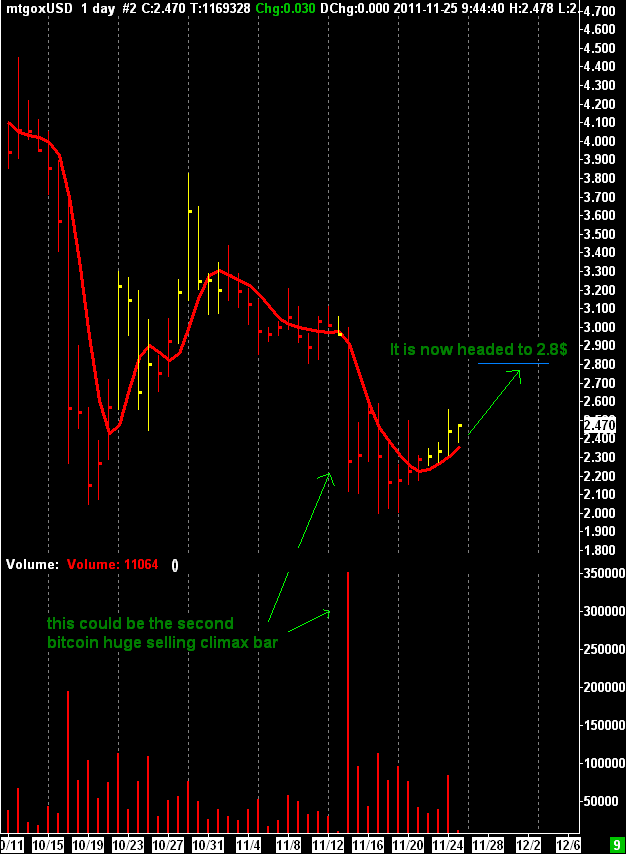
Initially i thought about a break down of the 2$ big support, but BTC/USD after a huge selling climax bar reacted to 2.47$, i now have to reassess my view giving 2.8$ as next target. Usually when a big downside bar develops its starting point become resistance and in this case the resistance is the 2.8$-3$ zone.

Only with a  genuine upside breakout of the Ross Hook at  the 3.8$ level the overall bearish scenario will change in favour of a bullish one. I’ll check if the BTC/USD will form again a 1-2-3 formation and possibly a new Ross Hook  for a lower entry point  (compared to the old one located at ~3.8$) where to go long on the market.


Short Term Update: MtGox

On October 18, 2011 i wrote “…I can speculate to project a new bottom and i’ve a new support at 1.50$ to be reached by the end of november….”, well i think that BTC/USD is on track to that target , i think that the 2$ bottom will not hold and bitcoin will soon test the 1.5$-1.7$ zone.

Why? BTC/USD  failed to pass through the Ross Hook at 3.8$ and resumed the downtrend. It is true that the weekly moving average is slowing and flattening but this process will require a couple of weeks to stabilize and eventually reverse to the upside, in the meantime the selling pressure will probably bring the bitcoin under 2$.


Long Term Update: Weekly Chart MtGox

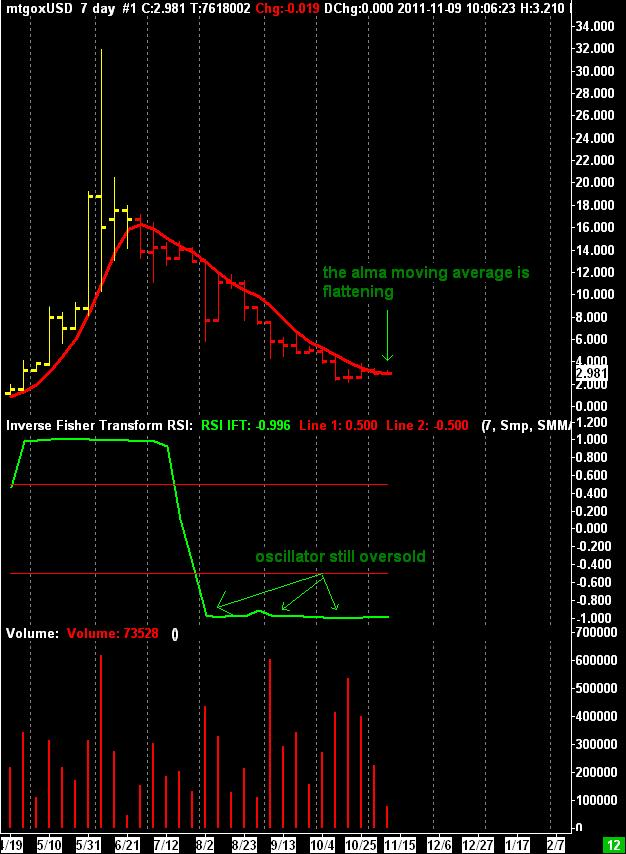
So far BTC/USD failed to go through 3.8$ but at least the weekly moving average is stabilizing after a fall of 4 months, since June. What doest it mean? well that at least prices are stabilizing in the 2.5$-3.5$ zone.  For now i think that the 2$ level should work for this month as support, resistance slightly under 4$.

The oscillator of course is still oversold, once it will cross the buy thresold and prices are above 4$ i’ll evaluate to open a long position or not.

Long Term Update: Daily Chart MtGox

As i explained in one of my previous post the Ross Hook is an elegant and clean method to trade stocks/commodities.
Here the BTC/USD, after a severe downtrend from 7$ to 2$, looks like it has reversed its direction following a 123 formation  (i repeat that a ross hook must occur after a 1-2-3 trend reversal formation has taken place) and make a Ross Hook at 3.82$, 3 days ago.
This price level was also an old bottom (7 october) now  of course resistance, BTC/USD going above 3.8$-3.9$ means also that my weekly moving average will reverse to the upside after a fall of many months, it could be a good buying opportunity if this scenario will materialize.

Long Term Update: MtGox Weekly Chart

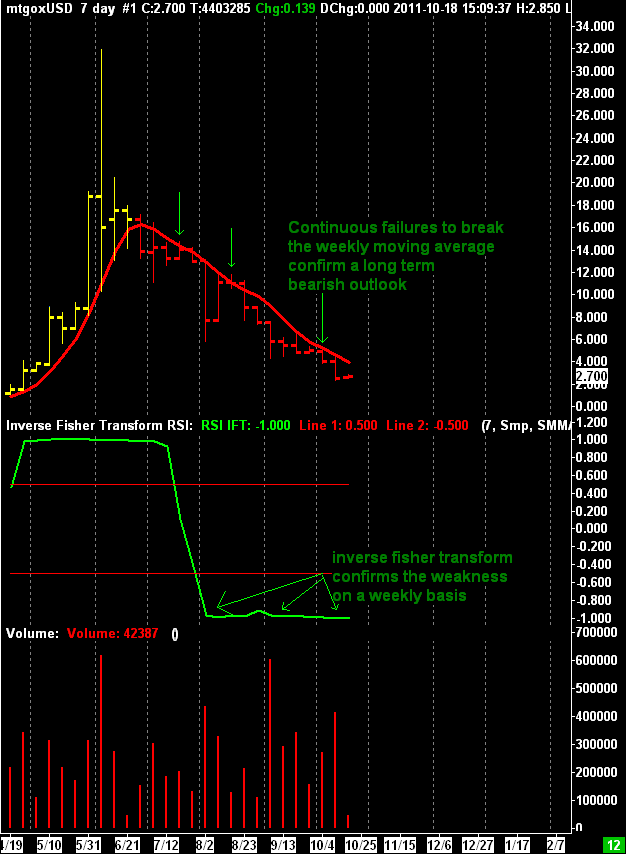
After failing again to break through my weekly moving average the BTC/USD moved to a new low of 2.26$, continuous failures to go above my reference weekly moving average is a confirmation of the overall bearish outlook at least on a weekly basis. I can speculate to project a new bottom and i’ve a new support at 1.50$ to be reached by the end of november. Also if i extend the current trajectory of my ALMA weekly moving average it will reach 1.5$ again by the end of November.

Considering that BTC/USD is always under my weekly average, it is a true possibility to see 1$ or even lower (due to a fast dip) in a month and a half from now.

Short Term Update: Daily Forecast

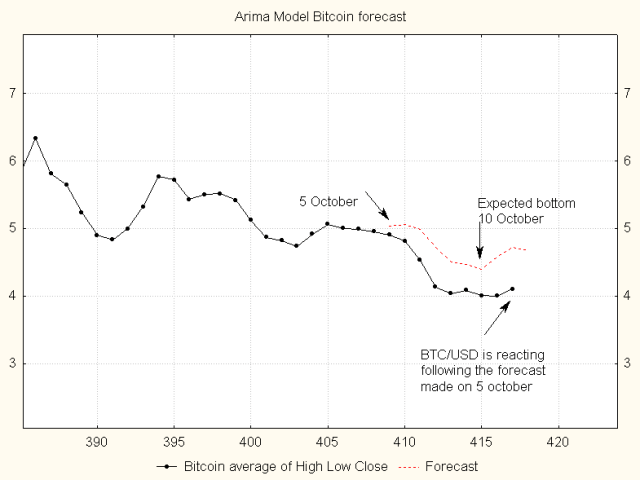
After eight days i checked the daily forecast made with an Arima model published on my latest post. I expect a modest rise in the next few days, probably not above the weekly moving average that at the moment is at 4.8$

Compared to the forecast the BTC/USD fell more then expected partially due to a large player that dumped 30k bitcoins on 7 October.

Long Term Forecast: MtGox

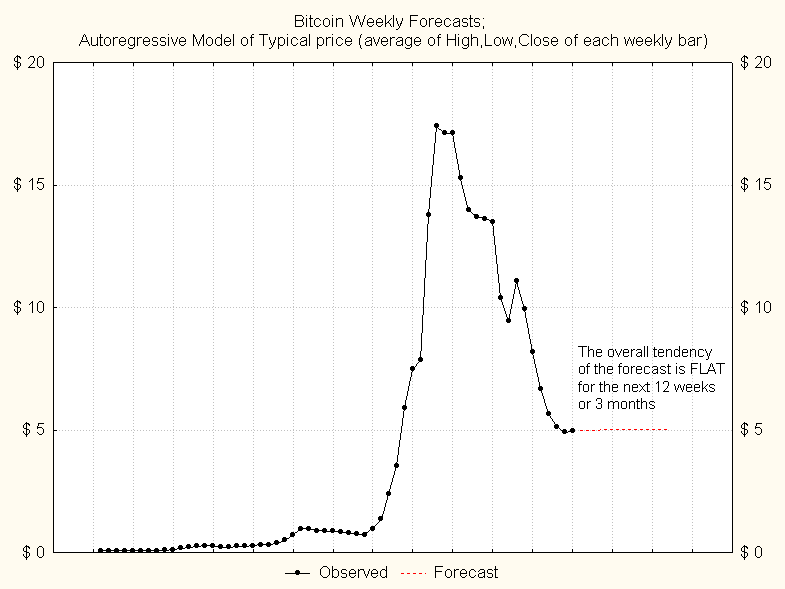
For doing this forecast i used the ARIMA or Autoregressive Integrated Moving Average. It is a statistical analysis model that uses time series data to predict future trends. It is a form of regression analysis that seeks to predict future movements along the seemingly random walk taken by a financial time serie by examining the differences between values in the series instead of using the actual data values.

This model type is generally referred to as ARIMA(p,d,q), with the integers referring to the autoregressive, integrated and moving average parts of the data set, respectively. In this case i used 1 set of autoregressive parameter p, 1 integrate d, and 1 moving average parameters q.
ARIMA modeling can take into account trends, seasonality, cycles, errors and non-stationary aspects of a data set when making forecasts, because of the absence of a proven bitcoin seasonality cycle and/or other cycles i ‘ve not included these aspects  in the forecast. More info about this kind of regression at http://en.wikipedia.org/wiki/Autoregressive_integrated_moving_average

Here’s the result using as input the weekly prices recored at MtGox, average of High,Low and Close of each weekly bar.
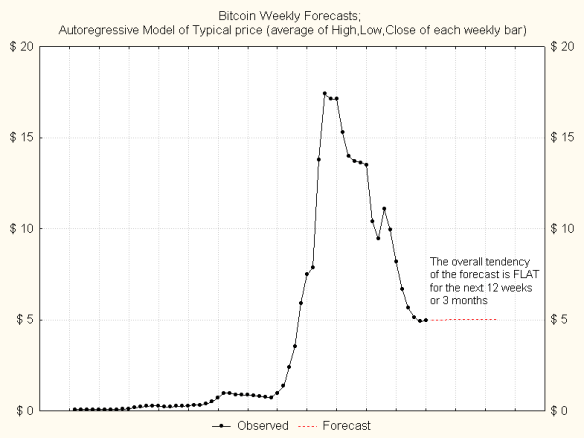
I’ve to add that due to the presence of a strong volatility around the forecasted value we might see wide swings ranging from 3$ to even 8-9$ in the next 3 months or so.

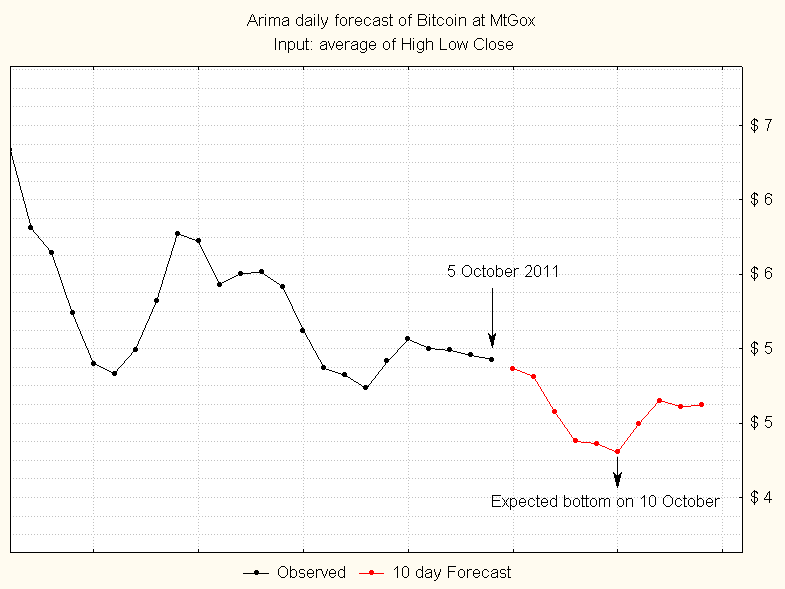
Here you can see an example of this regression technique applied this time to daily data of Mtgox
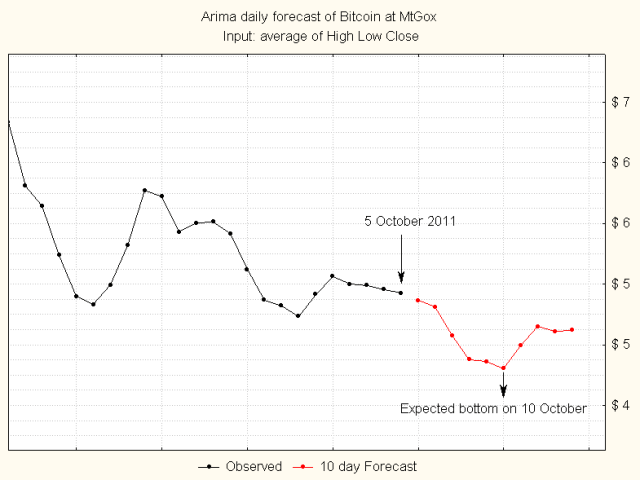
 

Will it work? Well only if the bitcoin will follow a 12 day cycle that i included in the forecast, why? i said in the past a couple of time that sometime a 12 days cycle model the bitcoin price movement; without this cycle the forecast is flat around 5$ as it is expected to be considering the last month spent around that level.  The effect of the 12 day cycle is not so strong as you can see in the attached chart, at max it might push the price down only to ~4.5$

I’ve to conclude saying that the internal dynamic of  bitcoin price time serie is not enough good to allow consistent and reliable forecasts (due to the lack of strong and consistent cycles) with these regression techniques, the confidence level of each forecast i made is very wide due to the presence of a strong volatility that diminish the usefulness of the forecast  itself.

This imply that the best trading strategy for the short term is to buy the dips and sell at the first bounce instead of relying on some sort of cycle forecast, and i think that this is what many traders at MtGox are already doing:)
Thanks and see you at the next update.

Long Term Update: MtGox Weekly Chart

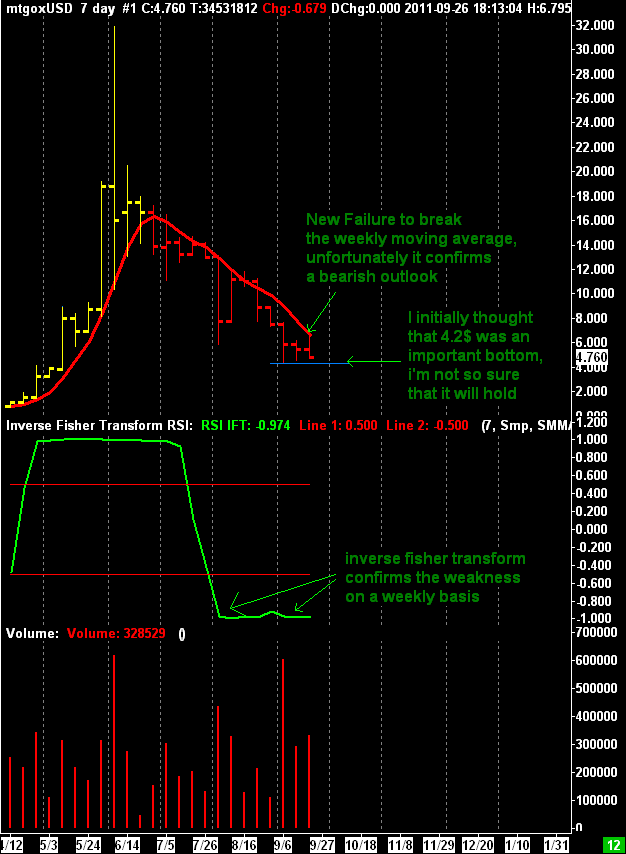
After failing to break through my weekly moving average the BTC/USD moved back to a short term downtrend with a lower top at 6.8$ after the previous one of 7.3$; i initially though that a bounce to 8.5$ was possible  but i was wrong, the market failed to going above 7.3$

At this point i’m not so sure about the main 4.2$ bottom, continuous failures to go above my reference weekly moving average is a confirmation of the overall bearish outlook at least on a weekly basis. I can speculate to project a new bottom and i’ve a new support at 4.1$ using an halved volatility factor, with a standard value i have a level around ~3.5$ where i think strong buyers will come back for a new buying opportunity.

Long Term Update: MtGox daily chart

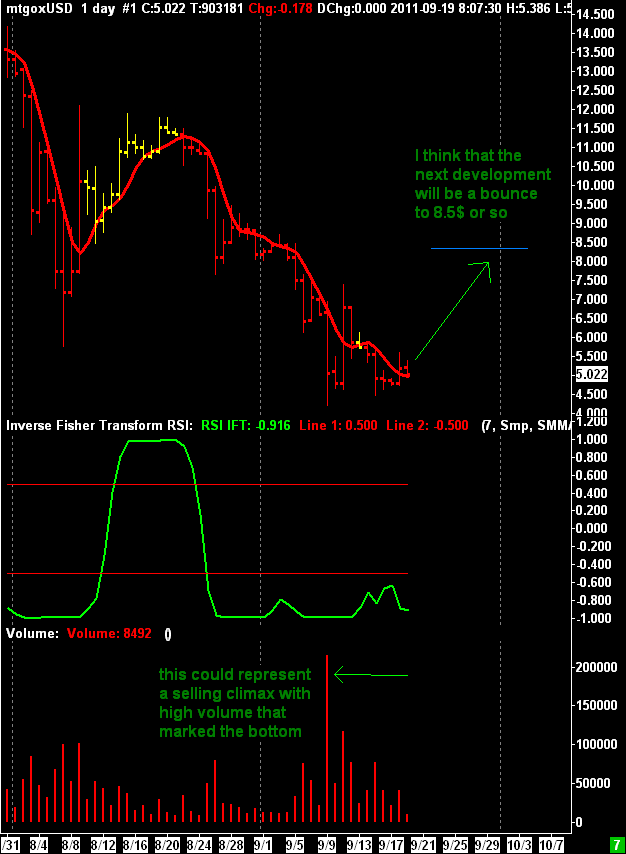
I think that the narrowing of the daily range of the last 5-6 days  it is a sign of exhaustion, especially since it has happened after the day the market just put in a selling  bar with high volume (~200000 bitcoins) on 9 september

As long as the  4$ bottom will hold i think that a bounce to 8.5$ or so will materialize in the upcoming weeks. At 7.5$ there is  my weekly moving average that so far worked very well, a penetration of that moving average will be a good sign of improvement for the long term trend. Thus i recommend to open a long term trade only after a clear breakout of 7.5$ using 4-4.5$ as stop loss.


Short Term Update: MtGox 4h chart

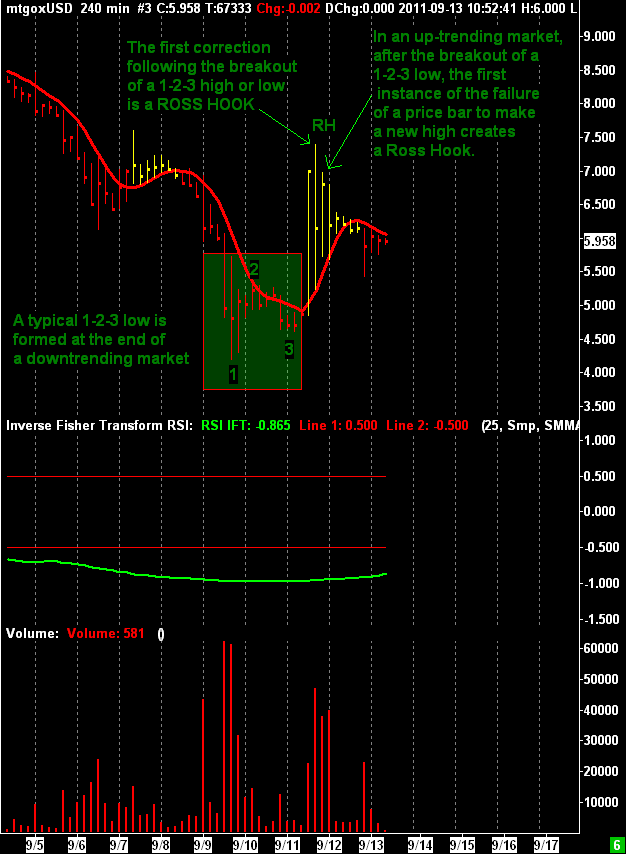
With this update i’d like to introduce a powerful concept, the “Ross Hook”. invented by Joe Ross, a trader and investor of over 50 years. 
Ok  but what is the ross hook? Well, the Ross Hook is a technical formation that occurs in trending markets where there is a failure of the market to make a new high in an uptrend or a new low in a downtrend. The Ross Hook must occur after a 1-2-3 trend reversal formation has taken place. As you can see on this 4h chart of btc/usd at MtGox in the last 5 days a 1-2-3 pattern formed with a first breakout labeled “RH” or Ross Hook.
Here the btc/usd failed to make a new low at the point “3” on the chart, then it has done a first strong breakout of point “2”, the first istance that failed to make a new high created the Ross Hook (labeled “RH” on the chart). If the market will go above the Ross Hook a trader might try to open a trade, in this case above ~7.3$; a breakout of 7.3$ would imply a temporary reverse in the short term.

For who is interested in this approach i recommend the book “Trading the Ross Hook”

Long Term Update: Weekly outlook at MtGox

I am very sad for all long term investors to report “No change” since my last weekly long term update, my weekly moving average has remained unchanged in its down movement and I am as pessimistic as ever that it will reverse soon.

Under the pressure of that moving average we are constantly falling and any attempt to rebounce failed to break above the average. I think that it will be difficult to avoid a breakdown of the 5.74$ august bottom, it will probably happen within the end of september or early october.

How long will the price fall last?
Well, i can’t say with certainty but i can compute an estimate of this weekly downswing assuming that it will last up to 25 weeks and average volatility, in this case i’ve as a target something around 3-4$, assuming instead a strong value of volatility i’ve ~2$ as possible target.

Long Term Update: MtGox daily chart

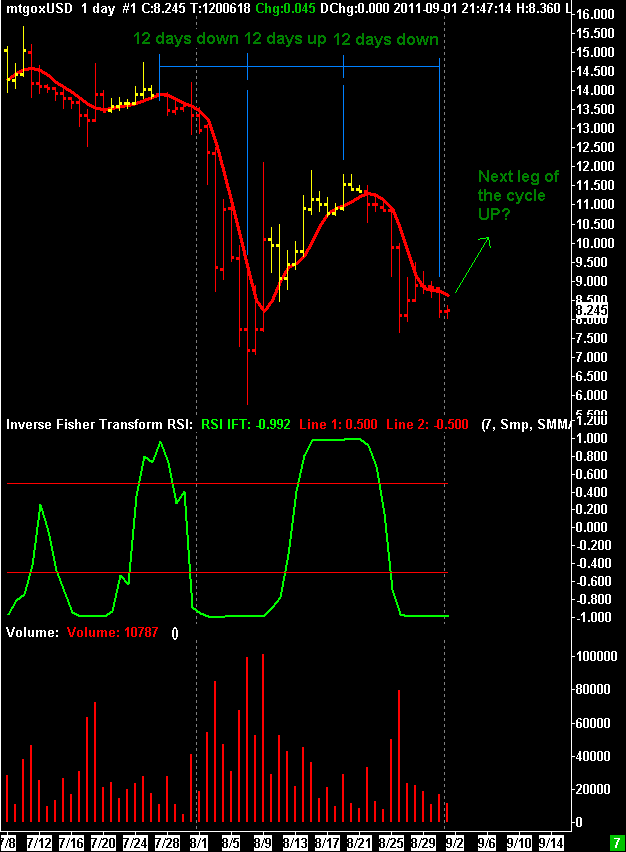
Often the BTC/USD follow a 24 days cycle (12 days up movement  followed by 12 days down movement), during the strong rise of april-june instead it followed a 12 days full cycle (6 up, 6 down). I dunno why, perhaps it’s tied to the ~12 days period of bitcoin difficulty adjustment. So far is working very well and as you can see in the left chart now a reverse of the cycle is due.

The fact that cycles exist does not imply that they exist all the time. Cycles come and goand external events sometimes dominate and obscure existing cycles. Experience shows that cycles useful for trading are present only about 15 to 30 percent of the time. This corresponds remarkably with J.M. Hurst’s statement that “23% of all price motion is oscillatory in nature and semi-predictable.” It is analogous to the problem of the trend follower who finds that the markets “trend” only a small percentage of the time.

I strongly recommend J.M Hurst book “The Profit Magic of transaction Timing”